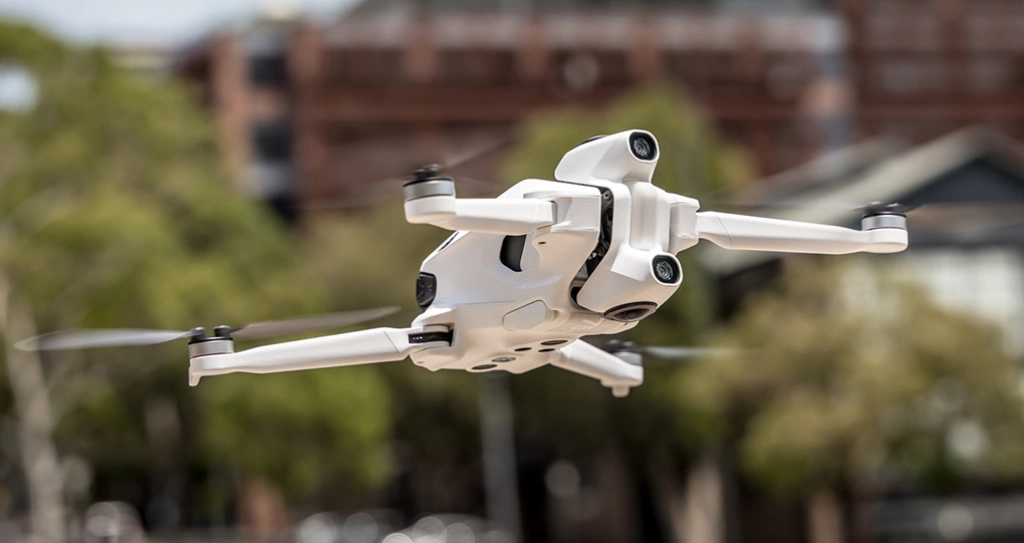
The drone industry witnessed a genuine breakthrough in December 2025 when Antigravity launched the A1, backed by Insta360’s proven technology. This isn’t another incremental DJI competitor. The A1 creates an entirely new category with real-time 360-degree viewing through FPV goggles.
After extensive testing throughout early 2026, this review examines whether the A1 justifies its $1,599 price and truly earns its “smartest drone” designation.
WHAT IS THE ANTIGRAVITY A1?
The Antigravity A1 is the world’s first consumer drone with an integrated 8K 360-degree camera streaming live panoramic video to FPV goggles. Unlike bolt-on solutions, the A1 was purpose-built around this technology from the ground up.
Weighing exactly 249 grams with its standard battery, the A1 sits just under regulatory thresholds requiring FAA registration in the US and operator licensing internationally. This weight class dramatically expands its potential user base while maintaining professional-grade capabilities.
The complete system includes Vision Goggles with head-tracking, Grip Motion Controller, and all accessories. Three bundles range from $1,599 to $2,099. TIME Magazine recognized it as a 2025 Best Invention before the first shipment.
ANTIGRAVITY A1 SPECIFICATIONS AND KEY FEATURES
Battery options: standard 2,360mAh delivers 24-minute max flight (15-17 real-world), while high-capacity 4,345mAh extends to 39 minutes max (25-28 real-world) but requires registration at 291g.
Dual 1/1.28-inch sensors capture 8K at 30fps, 5.2K at 60fps, or 4K at 100fps. Still photos reach 55 megapixels. Fast charging takes 45-60 minutes via the 65W GaN charger.
OmniLink 360 transmission achieves 2km range across 2.4/5.2/5.8 GHz bands. Safety includes obstacle sensors, emergency brake, return-to-home, and payload detection, preventing unauthorized modifications.
DESIGN, BUILD QUALITY AND PORTABILITY
Foldable arms collapse to 141×96×81mm, fitting easily in pockets. The reinforced polymer chassis handles typical use but isn’t crash-resistant like racing quads.
Dual 180-degree fisheye lenses are user-replaceable. Mechanical landing gear deploys automatically, protecting the bottom lens during takeoff and landing.
Build quality impresses for a first-generation product. The complete system fits in the included sling bag at under 2kg, making it genuinely travel-friendly.
REAL-WORLD PERFORMANCE TESTING
Testing in 20mph winds revealed operational limits. The 249g airframe maintained position, but forward progress slowed. Beyond 25mph becomes inadvisable. Image quality degraded slightly from increased stabilization.
The drone proved remarkably quiet at 150 meters. The emergency brake worked flawlessly. Obstacle avoidance detected thin branches reliably in C and N modes. S mode disables sensors for speed.
The heat stayed moderate after maximum flights in 30°C temperatures. The charging hub handled three batteries in approximately 3 hours.
BATTERY TECHNOLOGY AND SAFETY SYSTEMS
Lithium-ion cells include integrated management handling over-charge protection, balanced charging, and temperature monitoring. The system prevents charging outside the 5-45°C range and automatically discharges to 60% after 10 days for longevity.
Low-voltage protection provides warnings at 30%, critical alerts at 10%, and forces return-to-home at 5%. Users report consistent performance after 50+ charge cycles with proper storage.
Payload detection monitors weight continuously, forcing landing if anomalies persist. This prevents weaponization while allowing legitimate accessories. GPS lock within 30-60 seconds enables return-to-home functionality.
ANTIGRAVITY A1 FOR TRAVEL AND CONTENT CREATION
The 360-degree workflow transforms content efficiency. One flight through a location produces material for multiple clips: forward-facing, upward reveals, backward-traveling, and overhead views. This matters tremendously when flight time is limited by battery or weather.
A compact profile suits van life and adventure travel perfectly. Quick deployment enables spontaneous aerial shots without elaborate setup. Standard USB-C charging from power banks removes AC power dependence at remote locations.
Sky Path autonomous waypoints enable pre-programmed flights, allowing non-pilots to enjoy immersive goggles experiences without learning manual controls. This democratizes FPV beyond technically capable users.
ANTIGRAVITY A1 VS DJI AVATA 2
The DJI Avata 2 represents the closest competitor at $1,000 versus the A1’s $1,599 starting price. This $600 difference buys unique 360-degree capabilities but sacrifices some traditional FPV advantages.
Flight performance favors the Avata 2 with lower latency (under 30ms versus 100ms+), acro mode for freestyle pilots, and 60mph top speed versus 30mph. Battery life is comparable at 23 minutes versus 24 minutes with standard batteries.
The fundamental difference lies in cameras. The Avata 2’s single sensor captures stunning 4K/60fps traditional footage requiring precise in-flight framing. The A1’s dual sensors capture everything in 360 degrees simultaneously, enabling post-production reframing but reducing effective per-angle resolution.
Weight classifications matter significantly. The A1 at 249g requires no registration with standard batteries. The Avata 2 at 495g mandates FAA registration and Part 107 licensing for commercial use.
Choose the Avata 2 for freestyle FPV flying, traditional cinematography, longer 10km+ range, or existing DJI ecosystem investment. Choose the A1 for solo content creation, beginner-friendly safety features, sub-250g portability benefits, or post-production flexibility over in-flight precision.
PROS AND CONS OF ANTIGRAVITY A1
Pros include fast charging enabling near-continuous shooting, genuine packability for hiking and travel, goggles doubling as a USB-C power bank, a transformative 360-degree viewing experience, and post-production freedom eliminating composition pressure during flight.
Cons reflect the $1,599 price barrier, limited per-angle resolution versus dedicated cameras, proprietary ecosystem lock-in, 249g weight reducing weather resistance, and real-world battery life of 15-17 minutes versus advertised 24 minutes with standard batteries.
WHO SHOULD BUY THE ANTIGRAVITY A1?
Solo content creators across travel and adventure genres gain immediate value from self-filming without second operators. Tech enthusiasts wanting cutting-edge innovation will appreciate category-creating products offering unique content opportunities.
Families discover that Sky Path enables non-pilots to enjoy immersive perspectives. Real estate professionals gain comprehensive documentation tools. Filmmakers exploring 360-degree direction find an accessible entry before committing to expensive professional equipment.
Avoid if requiring acro mode for racing, prioritizing maximum single-angle quality, wanting budget-friendly entry, or preferring to wait for second-generation refinements and potential price reductions.
PRICING, AVAILABILITY AND WARRANTY
Standard bundle ($1,599) includes drone, battery, goggles, and controller. Explorer bundle ($1,899) adds a second battery and charging hub. Infinity bundle ($2,099) provides three high-capacity batteries, a hub, and a premium case.
Replacement components available separately: batteries ($79), controllers ($199), propellers ($19), lenses ($49). One-year warranty covers manufacturing defects. Extended warranty options with crash protection launching in Q1 2026 will provide additional peace of mind.
FINAL VERDICT
The Antigravity A1 achieves genuine category creation rather than incremental improvement. For specific audiences benefiting from 360-degree capabilities, the A1 delivers transformative value through two-person workflow efficiency and multiple videos from single flights.
First-generation status shows in areas where established competitors excel: traditional image quality, latency performance, and ecosystem maturity. However, the immersive flight experience genuinely lives up to marketing claims, creating sensations that screenshots cannot convey.
Build quality exceeded expectations for a newcomer’s first product. Nothing felt prototype-grade during extensive testing throughout early 2026. The competitive landscape intensifies with DJI’s Avata 360 arrival expected mid-2026.
Final scoring places the A1 at 8.5 out of 10. Points deducted reflect first-generation compromises, premium pricing, and niche positioning. Points earned recognize genuine innovation, excellent execution, and experiences impossible with alternatives, regardless of budget.
Recommendation: Buy the A1 if you’re a content creator regularly leveraging 360-degree capabilities, value immersive experiences over traditional piloting, can afford premium pricing without financial strain, or want genuinely new technology before mainstream adoption.
The Antigravity A1 represents a bold bet on 360-degree content becoming mainstream rather than novelty. The technology delivers on promises today, making this future accessible to early adopters ready to embrace it in 2026.