You have been waiting for Samsung to get this right. After years of foldables that felt like compromises wrapped in expensive glass, the Galaxy Z Fold 7 arrives asking you to forget everything that frustrated you before. Thinner. Lighter. A serious camera upgrade. But does it finally earn that $1,999 price tag, or is it still a gadget for enthusiasts willing to overlook real-world shortcomings?
I used the Z Fold 7 as my daily driver for several weeks. Here is what you actually need to know before spending $2,000.
Design & Build
The moment you pick up the Z Fold 7, you feel something fundamentally different. At just 4.2mm unfolded and 215 grams, Samsung trimmed away everything that made previous Folds feel like bricks in your pocket. To put it in perspective, the Z Fold 7 weighs less than the Galaxy S25 Ultra, and that is a regular slab phone.
The Advanced Armor aluminum frame is rigid and premium in hand. The hinge snaps open and closed with satisfying precision. Gorilla Glass Victus Ceramic 2 protects the cover, and the phone lies completely flat when open. The IP48 rating covers splashes and dust particles larger than 1mm — not fully dustproof, but good enough for daily life. Colors on offer are Jet Black, Blue Shadow, Silver Shadow, and an exclusive Mint through Samsung’s store.
Displays
Two screens, both genuinely excellent. The 6.5-inch cover display now runs at a proper 21:9 aspect ratio, which means it finally feels like a real smartphone when folded shut. At 2520×1080 resolution and 422ppi with 120Hz adaptive refresh, it handles scrolling, texting, and quick checks with ease.
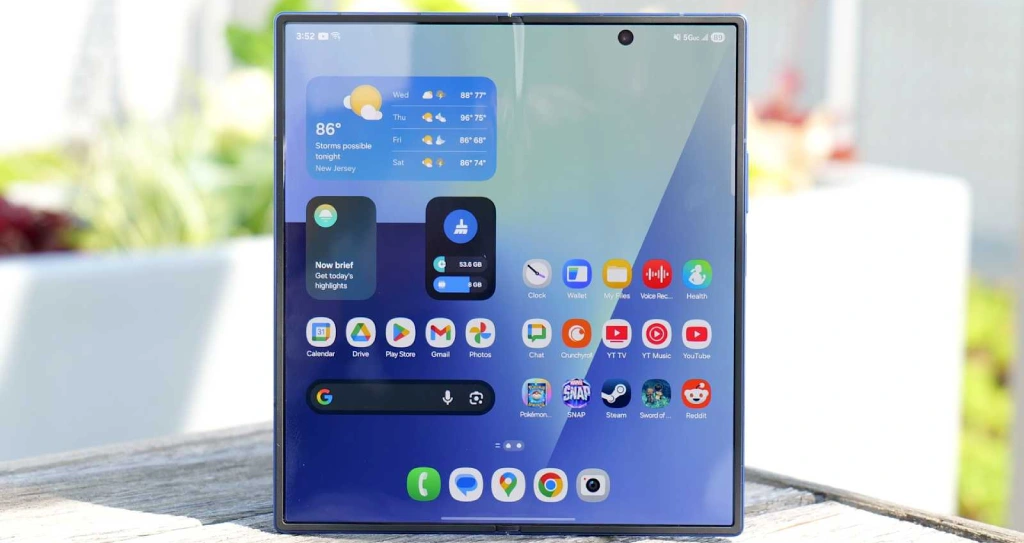
Open the phone, and the 8.0-inch inner display takes over at 2184×1968 resolution — nearly square, vivid, and capable of reaching 2,600 nits in direct sunlight. HDR10+ content pops with deep blacks and wide color. The crease running down the center is noticeably reduced from the Fold 6 and beats most Chinese competitors on that front.
Performance & Multitasking
The Snapdragon 8 Elite for Galaxy handles everything without hesitation. Three-window multitasking on the inner display runs butter smooth. Heavy apps, gaming sessions, and AI tasks hit no walls during extended use. There are no throttling issues during normal daily operation.
Samsung’s multi-window system has genuinely matured. Running two apps side by side with a floating third window is the workflow the inner screen was built for. Samsung DeX adds a desktop mode when connected to a monitor, turning this phone into a capable light laptop replacement for meetings and travel. That dual-purpose capability is a real, tangible advantage over any conventional smartphone.
Camera
This is Samsung’s biggest upgrade in the Z Fold 7. The 200MP ISOCELL HP2 main sensor borrowed from the Galaxy S25 Ultra is a genuine improvement over anything the Fold line has shipped before. Daytime photos have sharp detail, accurate exposure, and solid dynamic range that holds up even in mixed lighting.
The 12MP ultrawide now supports autofocus, enabling close-distance shots that were impossible on earlier Fold cameras. The inner selfie camera jumps from a barely usable 4MP under-display lens to a proper 10MP hole-punch camera, and video calls finally look the way they should on a device this expensive.
The weak point is the 10MP 3x optical telephoto. Stopping at 3x zoom while the Pixel 9 Pro delivers 5x optical zoom feels like a compromise hidden inside a premium chassis. Samsung’s ProVisual Engine with AI processing improves digital zoom output, but results are softer than optical alternatives at the same price tier. If long-distance photography matters to you, keep this in mind.
Battery & Charging
The 4,400mAh battery is the same as the Fold 6. That is the honest disappointment in this review. Samsung made the phone thinner and lighter without increasing the battery, and on heavy days, when the inner display is frequently in use, you will be reaching for a charger before dinner.
Charging tops out at 25W wired and 15W wireless. For a $1,999 device, this is below expectations, the Galaxy S25 Ultra charges at 45W. Reverse wireless charging at 4.5W handles earbuds in a pinch. Samsung claims 50% in around 30 minutes with a compatible adapter, which is acceptable rather than impressive. The missing Qi2 magnets mean popular wireless accessories require a separate case purchase.
Software & AI Features
Android 16 with One UI 8 powers the Z Fold 7, and Samsung promises 7 years of OS and security updates. That long-term commitment is among the best in the Android ecosystem and meaningfully increases the value of a $1,999 investment over time.
Galaxy AI features are practical rather than gimmicky here. Audio Eraser removes unwanted background noise from videos with a single tap. Photo Assist previews edits side-by-side before applying. Now Brief surfaces a personalized daily summary on the cover screen each morning. Circle to Search lets you grab any text or object from any screen and search it instantly. For the multitasking power user this phone targets, these tools add up to a meaningfully better experience than stock Android.
What’s Missing
No S Pen support. Samsung dropped it entirely from the Z Fold 7, and if you were a Fold user who relied on the stylus for handwritten notes or sketches, this is a genuine loss. The decision to achieve a slim body cut off power users who had built workflows around the S Pen.
The absence of Qi2 magnet integration, slower charging speeds, and no upgrade to the telephoto system are all real gaps at this price. Chinese competitors like Honor and Oppo are pushing silicon-carbon batteries with faster charging into thinner foldable bodies. Samsung wins on software maturity and brand reliability, but the Z Fold 8’s hardware specifications leave room for it to close the gap.
Samsung Galaxy Z Fold 7 Vs Galaxy S23 Plus
If you are upgrading from a Galaxy S23 Plus, the decision is more about lifestyle than raw specs. The S23 Plus offered 45W charging, a reliable triple camera, a 4700mAh battery, and a straightforward single-screen experience at a fraction of the Fold 7’s price.
The Z Fold 7 wins on display real estate, multitasking depth, and the newer 200MP camera hardware. The inner screen genuinely changes how you work — from document review to media consumption. But for users who primarily text, browse, and take photos on a single screen, the S23 Plus experience remains more friction-free.
If the Galaxy S-series interests you in 2026, read our detailed breakdown of the Samsung Galaxy S26 specs and features before making a decision.
Pros And Cons
| Pros | Cons |
| ✔ Ultra-slim 4.2mm unfolded — lightest Fold ever at 215g | ✘ S Pen support dropped entirely from the lineup |
| ✔ 200MP main camera now matches Galaxy S25 Ultra quality | ✘ Only 25W wired charging at a $1,999 price point |
| ✔ Wider 6.5-inch cover screen with proper 21:9 ratio | ✘ 3x optical zoom — limited vs Pixel 9 Pro’s 5x |
| ✔ 8-inch inner display — huge multitasking upgrade | ✘ 4,400mAh battery unchanged from Fold 6 |
| ✔ Snapdragon 8 Elite — flagship-grade performance | ✘ IP48 rating — not fully dust resistant |
| ✔ 10MP hole-punch inner camera (up from 4MP UDC) | ✘ No built-in Qi2 magnets for wireless accessories |
| ✔ Android 16 with 7 years of OS and security updates |
Should You Buy The Samsung Galaxy Z Fold 7 In 2026?
Buy it if the large inner display and multitasking capability genuinely change how you work. Road warriors, content creators, and productivity-focused professionals who want a single device that handles both phone and tablet duties will find that the Z Fold 7 delivers real value. This is the best book-style foldable on the market right now.
Skip it if you are a casual user. At $1,999, the compromises on battery endurance and charging speed are harder to justify when a Galaxy S25 Ultra or a well-priced Pixel handles daily tasks with less friction at a lower cost.
Looking for a strong alternative at a more accessible price? Our Google Pixel 10a review covers one of the best value smartphone options available right now.
Final Verdict
The Samsung Galaxy Z Fold 7 is the first foldable from Samsung that feels truly finished. The design is stunning, the 200MP camera is finally worthy of the asking price, and the multitasking experience on the inner display is genuinely better than anything a slab phone can offer.
The missing S Pen, slow charging, and limited 3x optical zoom are real gaps at $1,999, not dealbreakers for the right user, but areas Samsung needs to close with the Fold 8. For 2026 buyers ready to embrace foldable technology, the Z Fold 7 sits comfortably at the top of its category.