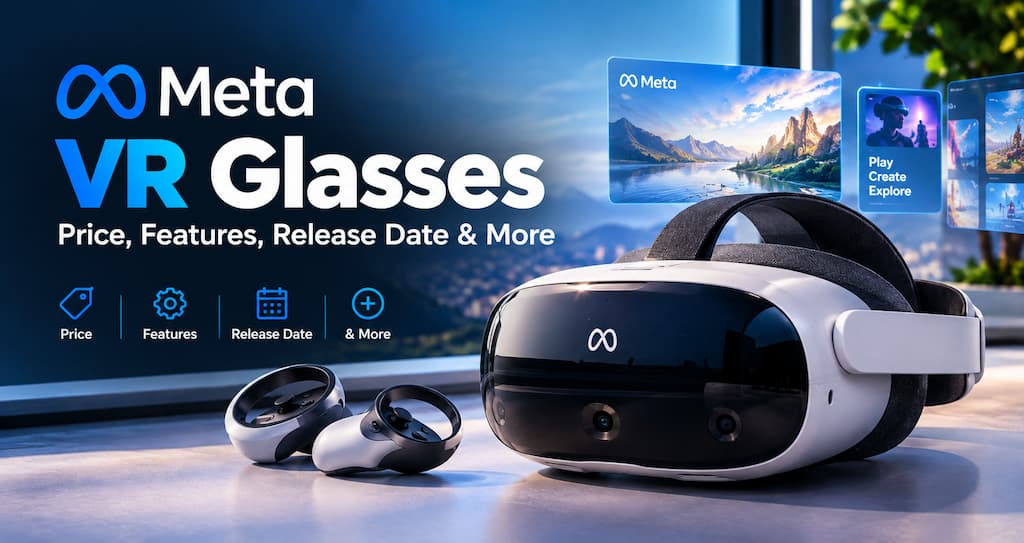
Meta VR Glasses are finally official. Meta unveiled the headset at Connect 2026 on September 23, after years of rumors under the codename Project Phoenix. However, you cannot buy it yet, because sales start in spring 2027.
That said, Meta already shared plenty of details. This guide covers the price, the main features, and the launch plan. Beyond that, it explains who should care about this headset and who should wait.
What Are Meta VR Glasses?
Meta VR Glasses are a mixed reality headset that looks closer to oversized glasses than a bulky visor. The frame weighs about 100 grams. Meta moved the battery and processor into a separate compute puck.
An optical cable links the puck to the frame.As a result, your face carries far less weight than it would with a typical headset.The puck weighs around 300 grams, so it slips into a pocket.
Importantly, these are not the same product as Ray-Ban Meta or the new Meta Glasses. Those are everyday AI smart glasses. Meta VR Glasses, on the other hand, deliver full virtual and mixed reality.
Meta VR Glasses Price
Meta priced the headset at $1,299.99. In other words, it lands firmly in premium territory. For comparison, the Meta Ray-Ban Display smart glasses cost $799, and the new Meta Glasses start at $299.
Meta sells the headset in two sizes, Standard and Large. Notably, each size is a separate SKU, so pick carefully when you order. The box includes a 45W USB-C power supply. However, it does not include controllers or a microSD card.
Additionally, expect a few extra costs. Touch Plus controllers are sold separately, unless you already own a Quest 3 or 3S. Prescription inserts come from Meta partner Zenni Optical, so glasses wearers should plan for those too.
Meta VR Glasses Release Date
Meta confirmed a spring 2027 launch, but it has not shared an exact date.Therefore, treat any specific day you see online as a guess.We will update this section when Meta announces more.
The company also plans a wide rollout.Meta lists 25 countries in total, including the US, UK, Canada, Germany, Japan, and Australia. Check Meta’s official page closer to launch to confirm your region.
Meta VR Glasses Features and Specs
Meta packed a lot into this small frame. Here is what matters most.
Display and Lenses
Meta calls the screen its 5K Infinite Display. It uses micro-OLED panels with 5.5 megapixels per eye (2,412 x 2,288). Furthermore, it reaches 37 pixels per degree, compared with 25 on Quest 3.
The lenses use a pancake design with built-in eye tracking. The field of view measures about 88 degrees diagonally. In addition, you can adjust the lens spacing between 56 and 70 mm, and the display runs at up to 120Hz.
Performance and Battery
Inside the puck sits Qualcomm’s Snapdragon Reality Elite chip, also known as XR2 Gen 3. It pairs with 12GB of RAM and 128GB of storage. Additionally, a microSD slot expands storage up to 1TB.
Battery life is modest. Meta claims more than three hours of mixed use. Fortunately, you can charge the puck while you play, using the included 45W power supply.
Controls and Sensors
Meta designed the headset around eye and hand tracking. You look at a button, pinch your fingers to select, and rub your thumb to scroll. As a result, you can use it without holding anything.
However, the headset also supports Touch Plus controllers for games that need them. Beyond that, it includes full-color passthrough cameras, depth sensing, autofocus, and iris detection for unlocking. A Surface Keyboard feature even turns any flat surface into a keyboard and trackpad.
Apps, Games and Entertainment
The headset runs the same operating system and store as Quest. Therefore, the whole Quest catalog works from day one. Meta also promises more than 75 games and apps that support hand gestures, including Beat Saber and Tetris Effect.
Streaming gets strong support too. At launch, you can expect Disney+, Peacock, HBO, YouTube, and Prime Video. Moreover, the headset carries IMAX Enhanced certification, with Dolby Vision and Dolby Atmos audio.
Productivity gets attention as well. You can stream multiple virtual screens from a Mac, PC, or phone. Additionally, a DisplayPort input lets you wire in a laptop, console, or handheld.
How Meta VR Glasses Compare With Meta’s Smart Glasses
Meta now sells three kinds of eyewear.Meta Glasses start at $299 and handle photos, calls, music, and Meta AI. The Meta Ray-Ban Display costs $799 and adds a small screen inside the lens.
Meta VR Glasses cost $1,299.99 and offer full immersive VR.Therefore, the right choice depends on your goal. For everyday wear, pick smart glasses. For immersive video, work, and gaming, pick the VR headset.
What to Know Before You Order
Start with the basics.Confirm your size, because Standard and Large ship as separate products. Next, decide how you plan to control the headset. If you love traditional VR games, budget for controllers.
Then think about your eyes. The lenses adjust for spacing from 56 to 70 mm, and Zenni Optical supplies prescription inserts. As a result, glasses wearers get a built-in fix.
Finally, plan your storage. The base model offers 128GB, which big games and movies can fill fast. Fortunately, the microSD slot gives you room to grow, although Meta does not include a card.
Who Should Buy Meta VR Glasses?
This headset suits people who want a lighter way to watch movies, work, and play casual games. For example, remote workers who want several virtual monitors will find plenty to like. Likewise, anyone who already owns Quest 3 controllers saves money.
However, the price is steep. Hardcore VR gamers should also think twice, because the box has no controllers. Finally, the headset has not shipped, so full reviews are still months away.
Final Thoughts
Meta VR Glasses look like Meta’s most serious attempt at a light, everyday headset.The sharp display, the 100-gram frame, and the Quest app library make a strong case. However, the $1,299.99 price and three-hour battery may hold some buyers back.
Overall, the smart move is to wait for hands-on reviews before spring 2027. If early impressions hold up, this headset could set a new bar for comfort.