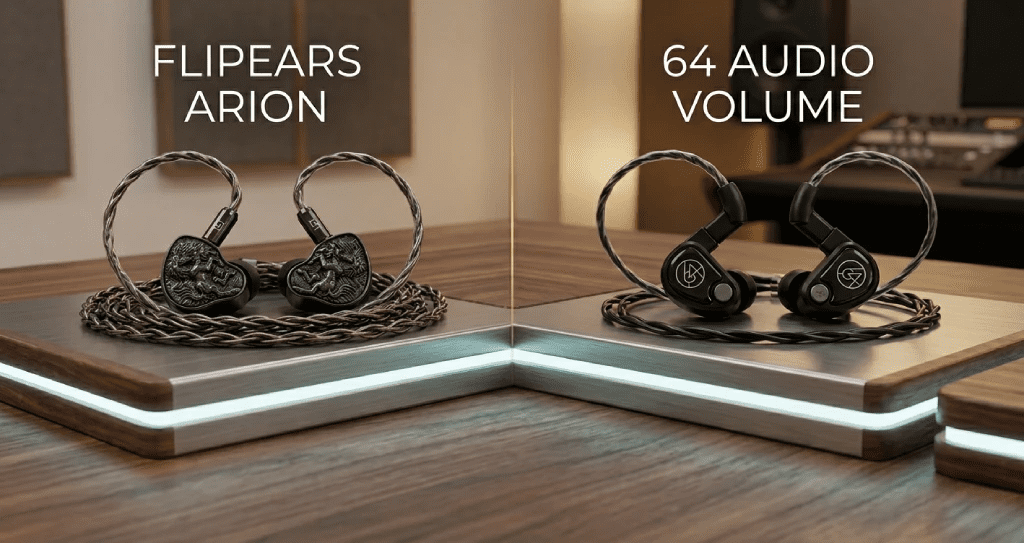
You’ve saved up. You’ve done the research rabbit hole: Reddit threads at 2 AM, YouTube comparisons with headphones plugged into a potato DAC, forum wars between people who’ve probably never even touched either IEM. And now you’re here, staring at two $2,500 flagship earphones wondering: which one actually deserves to live in my ears?
That’s the real question. Not which has more drivers, not which has the fancier acronym, but which one, when you press play on a track you love, makes you forget everything else.
This comparison cuts through the noise. Real sound impressions. Real-world use cases. A clear verdict. No hedging.
Quick Comparison
| Feature | FlipEars Arion | 64 Audio Volur |
| Driver Type | Quadbrid (BA + DD + EST + Bone Conduction) | Multi-driver Hybrid |
| Tuning | Fixed, bold, musicality-first | Modular via apex modules |
| Design | Handcrafted resin, jewelry-level finish | Anodized aluminum, studio-grade |
| Bass Character | Tactile, physically engaging, dominant | Articulate, controlled, accurate |
| Mids | Warm, forward, emotionally rich | Transparent, natural, reference-grade |
| Treble | Energetic, sparkly, extended | Refined, precise, fatigue-free |
| Soundstage | Wide, cinematic, immersive | Holographic, surgical, deep layering |
| Best For | Music lovers, bass enthusiasts, audiophiles who feel music | Studio pros, reference listeners, critical listeners |
| Price Tier | Flagship | Flagship |
Design & Build Quality
Pick up the FlipEars Arion and you’ll understand why people compare it to jewelry more than audio gear. The handcrafted resin shells are individual; no two pairs are truly identical, and that’s by design. The faceplates have a depth to them that photographs cannot capture. It’s the kind of thing you show people who aren’t even into audio, and they say “wait, that goes in your ear?”
The 64 Audio Volur plays it differently. Anodized aluminum shells, clean lines, functional beauty rather than expressive beauty. It’s the kind of design language that says I’m serious about what I do rather than look at me. The fit across different ear shapes is impressively consistent, and after hours of wearing it, there’s no fatigue from the shell itself. Studio engineers and critical listeners appreciate this kind of purposeful restraint.
Cable quality is worth noting: the Arion ships with a 2-pin Eleetch cable in 4.4mm termination, which is a premium pairing. The Volur’s silver-plated OCC copper cable is equally serious, but the real differentiator in the box is the inclusion of mX, m12, and m20 APEX modules. These are 64 Audio’s proprietary pressure-relief system that also subtly shapes bass response. That’s a meaningful hardware advantage for listeners who like to fine-tune.
Quadbrid vs. Hybrid: What Actually Matters
This is where the philosophies diverge most sharply.
The FlipEars Arion runs a quadbrid configuration: balanced armatures, a dynamic driver, electrostatic tweeters, and a bone conduction driver working together. Bone conduction in an IEM is still relatively rare, and its contribution isn’t subtle. It creates a low-frequency experience that doesn’t just play bass; it delivers it. You feel the physicality of a kick drum in a way that conventional IEMs simply can’t replicate. This is hardware-level differentiation, not just tuning.
The 64 Audio Volur takes a different path. Its hybrid architecture combines multiple drivers with 64 Audio’s signature technologies, including the APEX module system, which vents ear canal pressure during playback. The practical effect is a listening experience that feels remarkably open for a sealed IEM, reducing listening fatigue significantly over long sessions. The Volur doesn’t try to physically move you; it tries to place you accurately inside the music.
Neither approach is objectively superior. They’re solving different problems.
Sound Performance
Bass
The Arion’s low end is the headline feature for most buyers. It hits hard, extends deep, and carries genuine texture. The bone conduction driver contributes a sub-bass physicality that makes electronic music, hip-hop, and film scores feel alive. This isn’t bloated, muddy bass; it’s impactful and controlled. But it is absolutely present, and it colors the experience.
The Volur’s bass is a different animal. Clean. Measured. Every note articulated, nothing bleeding into adjacent frequencies. Sub-bass extension is excellent but it doesn’t announce itself. It supports the mix the way a great double bass player supports a jazz ensemble without dominating it. If you want to hear bass with forensic clarity, the Volur wins. If you want to feel it, the Arion wins.
Midrange
Vocals on the Arion have body and warmth. There’s an intimacy to how singers sit in the mix: forward, emotionally present, slightly romanticized. Acoustic guitars feel rich. Synths feel lush. It’s tuned to maximize musicality over clinical accuracy, and for most music lovers, that’s exactly the right call.
The Volur’s midrange is where audiophiles and studio professionals tend to fall in love with it. Every micro-detail surfaces cleanly: breath before a phrase, finger movement on frets, room ambience. It’s not cold, but it doesn’t editorialize. It gives you what was recorded. If you’re the kind of listener who’s curious whether that was a Neumann U87 or a Telefunken ELA M 251, the Volur will tell you. The Arion will make you not care, because it sounds so good regardless.
Treble
The Arion’s highs are extended and lively, adding sparkle and air without the kind of sharpness that causes ear fatigue over long sessions. There’s energy in the upper registers that complements its bass-forward presentation, giving the overall sound a sense of excitement and scale.
The Volur’s treble is more measured. Precise without being bright, extended without being fatiguing. For long critical listening sessions or studio monitoring work, this controlled top end is a genuine asset. The tradeoff is that some listeners find it less “exciting” on first listen, but exciting and accurate are not the same thing.
Soundstage And Imaging
Here’s a clear split: the Arion wins on width and immersion; the Volur wins on precision and depth.
Listening to an orchestral recording on the Arion feels like sitting center-hall in a large concert venue: enveloping, cinematic, breathtaking in scale. Switching to the Volur on the same recording feels like moving from the audience to the mixing console. Suddenly you can pinpoint where every instrument sits, how far left the first violin section is, the precise distance of the percussion. It’s almost open-back in its spatial presentation.
For gaming and film scoring enthusiasts, the Arion’s immersion is extraordinary. For studio work and critical A/B listening, the Volur’s imaging accuracy is unmatched.
Real-World Use Cases
Arion in the wild: You’re commuting, playlist running, and “Blinding Lights” kicks in with a bass line that hits your chest at exactly the moment you needed it to. You’re at home on a Friday night playing an RPG soundtrack through your DAP, eyes closed, fully transported. You’re the person who reads gear forums but genuinely, fundamentally loves music more than specs.
Colour in the wild: You’re a mixing engineer cross-referencing your monitors against your IEMs. You’re evaluating masters for a streaming release. You’re the kind of listener who hears a recording and notices that the kick drum was compressed too hard in the mid-range. You listen to music with intent, not just as background.
Both are exceptional for:
- Classical and jazz (Volur edges Arion on transparency; Arion makes it feel more alive)
- Electronic and hip-hop (Arion edges Volur significantly; the bass physicality is a game-changer)
- Rock and metal (close call; Arion’s energy suits the genre; Volur offers better mix clarity)
- Acoustic and vocal recordings (Volur’s micro-detail retrieval is exceptional)
- Film scores and soundtracks (Arion’s cinematic soundstage wins here)
For those considering other premium options in this tier, our Sennheiser IE 80 review offers an interesting reference point for how German acoustic engineering approaches musicality, a useful contrast to both of these approaches. And if you want to understand what “spatial audio done right” means at a different price point, the Dali IO-12 review shows what happens when a speaker company applies its philosophy to headphones.
Pros and Cons
FlipEars Arion
Pros:
- Bone conduction bass is genuinely unique and physically engaging
- Handcrafted aesthetics are unmatched in the flagship IEM space
- Midrange warmth and vocal presence are immediately emotional
- Cinematic soundstage scale rewards immersive listening
- Energetic treble that adds excitement without harshness
Cons:
- Fixed tuning with no module-based customization
- Bass emphasis may not suit purist reference listeners
- Less surgical imaging compared to the Volur
- Heavier than some may prefer for extended wear
64 Audio Volur
Pros:
- APEX module system provides genuine tuning flexibility
- Reference-grade midrange transparency is studio-ready
- Holographic imaging and layering is best-in-class
- Fatigue-free for multi-hour listening sessions
- Tonal accuracy across all genres is excellent
Cons:
- Less viscerally exciting bass than the Arion
- First listen can underwhelm before your ears adjust to the reference presentation
- Design is functional rather than expressive
- At this price, some listeners expect more “wow” from the packaging
Who Should Buy the FlipEars Arion?
Buy the Arion if you feel music more than you analyze it. If bass is a physical experience for you, not just a frequency range. If you’re spending $2,500 because you want to be moved, not just informed.
This is also the right choice if you listen to electronic music, hip-hop, rock, or cinematic scores for pleasure. The Arion rewards genres that benefit from physicality and scale. It’s an emotional investment in sound, and it delivers on that promise.
Who Should Buy the 64 Audio Volume?
Buy the Volur if you’re a working professional who needs IEMs that tell the truth. If you’re mixing, mastering, A/B testing, or evaluating recordings, the Volur is an actual tool, not just a listening pleasure device. The APEX module flexibility is meaningful for different acoustic environments.
It’s also the right choice for classical, jazz, and acoustic music lovers who want every detail delivered faithfully. Or for anyone who’s done enough listening to know that “exciting” and “accurate” are different things and they’ve made their peace with that.
Final Verdict
For pure musical enjoyment and bass-forward listening: FlipEars Arion wins.
For studio accuracy, reference monitoring, and technical listening: 64 Audio Volur wins.
But here’s the verdict most comparison articles won’t give you: if you’re a music lover first, the Arion is likely the better $2,500 spent. The bone conduction driver alone creates an experience that doesn’t exist elsewhere at any price. The emotional impact of that tuning is rare. You will reach for it constantly.
The Volur is the better tool, and an extraordinary one. If your use case involves professional evaluation or you genuinely prefer reference tonality, it justifies every dollar. But it’s a demanding listen that reveals how good the recording is as much as how good the music is.
If someone made me choose one and keep it forever? I’d miss Volur’s imaging. But I’d reach for the Arion every single time.
FAQ’s
Is FlipEars Arion better than 64 Audio Volume?
It depends entirely on what you value. The Arion is better for emotional, bass-forward, immersive listening experiences. The Volur is better for reference accuracy, studio work, and clinical listening precision. Neither is objectively superior; they represent different philosophies.
Which IEM is best for bass lovers?
The FlipEars Arion, without question. Its quadbrid configuration with bone conduction delivers a tactile, physically engaging low end that no conventional IEM can match. If you want bass you feel as much as you hear, the Arion is the answer.
Are either of these worth $2,500?
Both are genuinely flagship-tier IEMs that justify their pricing through driver innovation, build quality, and sound engineering. The value calculation depends on your use case. For professional work or serious audiophile listening, yes. For casual use, there are excellent options at lower price points.
Which is better for studio monitoring?
The 64 Audio Volume. Its reference-grade midrange, precise imaging, APEX pressure-relief modules, and neutral tonal balance make it the professional’s choice. The Arion’s musicality and bass presence make it less suitable for critical reference work.
Can the 64 Audio Volume be customized?
Yes. The APEX module system (mX, m12, m20) allows users to adjust air pressure relief and subtly shape the bass response. This is a meaningful hardware customization that the Arion does not offer.
Which has the better soundstage?
It depends on what “better” means to you. The Arion has a wider, more cinematic soundstage that emphasizes immersion and scale. The Volur has a more precise, holographic soundstage that emphasizes instrument separation and imaging accuracy. Immersion vs. precision: know which matters more to you before deciding.
Ready to Decide?
Both the FlipEars Arion and the 64 Audio Volur are exceptional expressions of what’s possible in a flagship IEM. But they’re not for the same person.
Choose the Arion if you want to feel music with your whole body, love genres that live and die by bass, and value the craftsmanship of something truly handmade.
Choose the Volume if you work with audio professionally, demand reference-grade transparency, or you’ve been on this audiophile journey long enough to know you want accuracy over excitement.
Either way, you’re not settling. You’re just choosing your priority, and that’s the smartest thing any buyer at this level can do.