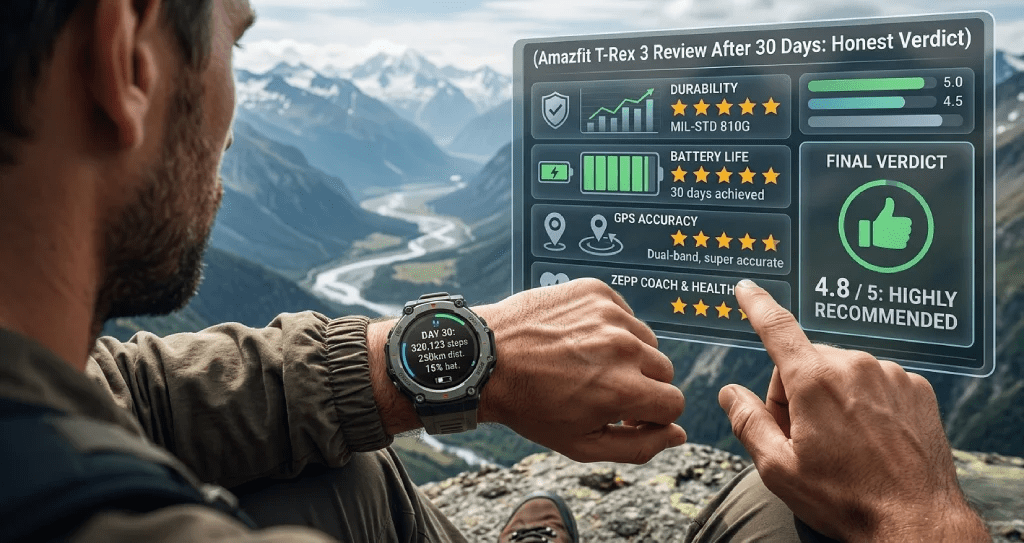
I’ll be upfront. I bought the Amazfit TRex 3 skeptically.
Amazfit has been putting out rugged-looking watches for years, but the early TRex models always had that frustrating gap between what they promised and what you actually got once you strapped them on and hit a trail. TRex 3 is supposed to change that story. Dualband GPS, 180 hours of claimed battery life, and a military-grade chassis that supposedly handles whatever you throw at it.
After 30 days of daily use, trial runs, weekend hikes, sleep tracking, gym sessions, and one particularly grim week of commuting in heavy rain here is where things actually stand.
Design & Build Quality
The TRex 3 is a big watch. If you have smaller wrists, check the dimensions before ordering — this thing has presence.
The case is made from reinforced fiber composite with a 316L stainless steel bezel. It does not feel cheap. The buttons have a satisfying click, the lugs are chunky, and it clearly passes the look tough test that rugged watch buyers care about.
It is rated to MILSTD810H standards across 15 military-grade tests, including temperature extremes, shock resistance, salt fog, and humidity. After a month of real use, including two scrambles on rocky terrain and a session in heavy monsoon rain, the built confidence is justified.
The silicone strap is comfortable enough for overnight sleep tracking, though after about three weeks, the buckle area started showing minor scratch marks. Not a dealbreaker, but worth knowing upfront.
Display & Brightness
This is one area where Amazfit has genuinely leveled up.
The 1.5inch AMOLED display at 454 x 454 resolution is crisp, colorful, and visible in direct sunlight without fighting through menu settings. Autobrightness works well in most conditions.
The always-on display (AOD) mode is usable, something I could not honestly say about earlier TRex generations. That said, enabling AOD noticeably affects battery life. If battery endurance is your priority, leave it off most of the time.
Navigating watch faces and widgets feels smooth. No lag, no dropped taps. The touchscreen responds reliably even with slightly damp hands.
GPS Accuracy & Outdoor Performance
This was the section I was most curious about and where the TRex 3 genuinely earns its money.
The watch uses dual-band GPS (L1+L5) with support for GPS, GLONASS, BeiDou, Galileo, and QZSS. On trail runs through areas with mixed tree cover and canyon sections, the tracks logged were accurate enough that I was not constantly correcting routes during post-run map reviews.
Lock-on time from cold start averaged around 8 to 12 seconds faster than I expected at this price point.
Compared to what I have seen from other midrange GPS watches, including the Huawei Watch GT Runner 2, the TRex 3’s dual-band system is a meaningful upgrade for anyone doing serious off-road navigation. Urban runs were essentially flawless.
One honest caveat: dense forest canopy still creates some drift. Nothing dramatic, but if you are doing technical alpine routes, do not sell your Garmin Fenix just yet.
Health & Fitness Tracking
The TRex 3 tracks the full standard suite heart rate, SpO2, stress levels, sleep stages, and a VO2 Max estimation.
Heart rate tracking during steady-state cardio was consistently accurate when cross-checked against a chest strap. During high-intensity intervals, there was the usual optical HR lag you see across wrist-based sensors. This is an industrywide limitation, not specific to Amazfit.
Sleep tracking stood out as one of the stronger performers here. The breakdown between light, deep, and REM stages felt believable over the 30-day period, not just randomly generated numbers as some budget trackers produce.
The Body Vitality energy readiness score (Amazfit’s version of a body battery metric) is genuinely useful if you train consistently. It kept me from overtraining on at least three occasions when my instinct said ‘go hard,’ but the watch disagreed.
If health tracking is your primary use case, you might also find value in reading this TicWatch E3 health tracking review for a comparison point at a lower price bracket.
Battery Life After 30 Days
Amazfit claims 180 hours of GPS battery life and roughly 20 to 26 days of smartwatch usage. Here is what I actually saw:
| Usage Scenario | Battery Life |
| Smartwatch mode (AOD off, notifications on) | 17–19 days |
| Heavy GPS use (2–3 hr/day, 4–5x per week) | 10–12 days |
| Full GPS tracking daily | 7–8 days |
| Advertised claim | Up to 26 days |
Is that disappointing versus the spec sheet? A little. But it is still exceptional compared to most competitors at this price. When I wore the Huawei Watch GT Runner 2 under similar conditions, I was charging every 9 to 11 days.
The real-world battery on the TRex 3 lands somewhere between really good and genuinely impressive, depending on your usage pattern. Just do not plan a three-week expedition on a single charge without checking your settings first.
App Experience & Features
The Zepp app, Amazfit’s companion platform, has improved considerably over the past two years.
The health dashboard is clean. Sleep and workout history are easy to navigate. Third-party integrations with Strava and Apple Health work without drama.
Where it still falls short: route navigation on the watch itself is functional but basic. The turn-by-turn breadcrumb navigation works, but if you are used to Garmin’s topographic map rendering, Amazfit is playing catch-up here.
Smart notifications, calendar sync, and music controls all work reliably. No complaints on the day-to-day smartwatch experience.
Pros & Cons
| ✅ PROS | ❌ CONS |
| Dualband GPS delivers genuinely accurate tracking | Navigation maps are basic compared to Garmin/Suunto |
| Build quality is solid and confidence inspiring outdoors | Battery doesn’t quite hit the advertised 26day claim |
| Battery life well above average for a GPS sports watch | Large case size won’t suit smaller wrists |
| AMOLED display is vivid and bright in sunlight | Optical HR struggles at very high intensity intervals |
| Health tracking (especially sleep) is reliable and useful | Zepp app can feel bloated with unused features |
| Comfortable for overnight wear |
Amazfit TRex 3 vs TRex 3 Pro
The TRex 3 Pro adds a few meaningful upgrades: an enhanced optical heart rate sensor, improved topographic map support, and, in some versions, a sapphire crystal glass lens.
For most buyers, especially anyone who is not doing technical mountain navigation, the standard TRex 3 is the smarter purchase. The price jump to Pro adds features that casual to intermediate outdoor users simply will not use enough to justify.
If you regularly run routes in unfamiliar mountain terrain and rely on wrist navigation, the Pro version makes sense. Otherwise, save the difference.
Is the Amazfit TRex 3 Worth Buying?
After 30 days: yes, with one clear caveat.
The Amazfit TRex 3 is the best value rugged GPS watch under its price point right now. The dual-band GPS is accurate, the build is legitimate, the battery outlasts most of the competition, and the health tracking has genuinely matured into something useful.
The caveat is navigation. If you need detailed topographic maps on your wrist for serious backcountry work, this watch will leave you wanting more. That is a Garmin or Suunto conversation.
But if you want a tough, capable outdoor watch that tracks your runs accurately, lasts weeks between charges, and does not cost Garmin money, the Amazfit TRex 3 delivers on what matters most.
FAQ’s
Q: How accurate is the Amazfit TRex 3 GPS?
The dual-band GPS (L1+L5) performs well on open trails and in urban environments. A dense tree canopy can cause minor drift, but for most outdoor activities, accuracy is comparable to watches costing significantly more.
Q: What is the real battery life of the Amazfit TRex 3?
In regular smartwatch use with GPS sessions four to five times per week, expect 10 to 15 days. The advertised 26-day estimate applies to low-activity usage with AOD and notifications minimized.
Q: Is the Amazfit TRex 3 good for hiking?
Yes. The MILSTD810H rating, accurate GPS, route tracking, and long battery make it a strong hiking companion. Just be aware that offline map support is limited compared to Garmin devices.
Q: Does Amazfit TRex 3 work with Strava?
Yes. Strava sync works through the Zepp app reliably on both iOS and Android.
Q: Is the Amazfit TRex 3 waterproof?
It carries a 10 ATM water resistance rating, making it suitable for swimming, snorkeling, and heavy rain without concern.
Q: How does the Amazfit TRex 3 compare to the Garmin Instinct 2?
The Garmin Instinct 2 has superior map navigation and a more established sports tracking ecosystem. The TRex 3 wins on display quality and offers comparable GPS accuracy at a lower price point.
Q: Is the Amazfit TRex 3 worth it in 2026?
For buyers wanting a rugged, accurate GPS watch with strong battery life at a midrange price, absolutely. It is one of the best value propositions in the rugged sports watch category this year.