Nothing Headphone (1) vs Bose QuietComfort Ultra: Which Premium Headphones Win?
Picking between the Nothing Headphone (1) vs Bose QuietComfort Ultra is genuinely one of the more interesting headphone debates right now, not because they’re equals, but because they appeal to very different kinds of buyers. One is a bold, design-forward statement from a young brand that wants to shake up audio. The other is the refined, battle-tested benchmark that audiophiles and frequent flyers have trusted for years. So which one actually deserves your money?
Let’s cut through the noise literally.
Quick Overview: Specs At A Glance
| Feature | Nothing Headphone (1) | Bose QuietComfort Ultra |
|---|---|---|
| Driver Size | 40mm dynamic | 35mm dynamic |
| ANC | Yes (adaptive) | Yes (CustomTune tech) |
| Battery Life | 40 hrs (ANC on) | 24 hrs (ANC on) |
| Charging | USB-C | USB-C |
| Weight | 290g | 250g |
| Bluetooth | 5.3, multipoint | 5.3, multipoint |
| Codecs | SBC, AAC, LDAC | SBC, AAC, aptX Adaptive |
| Companion App | Nothing X | Bose Music |
| Spatial Audio | Yes (head tracking) | Yes (Immersive Audio) |
| Price (approx.) | $199 / £179 | $429 / £380 |
The price gap alone tells a story. But the real question is whether Bose earns that $230 premium or whether Nothing has quietly built something that punches well above its cost.
Design & Build Quality
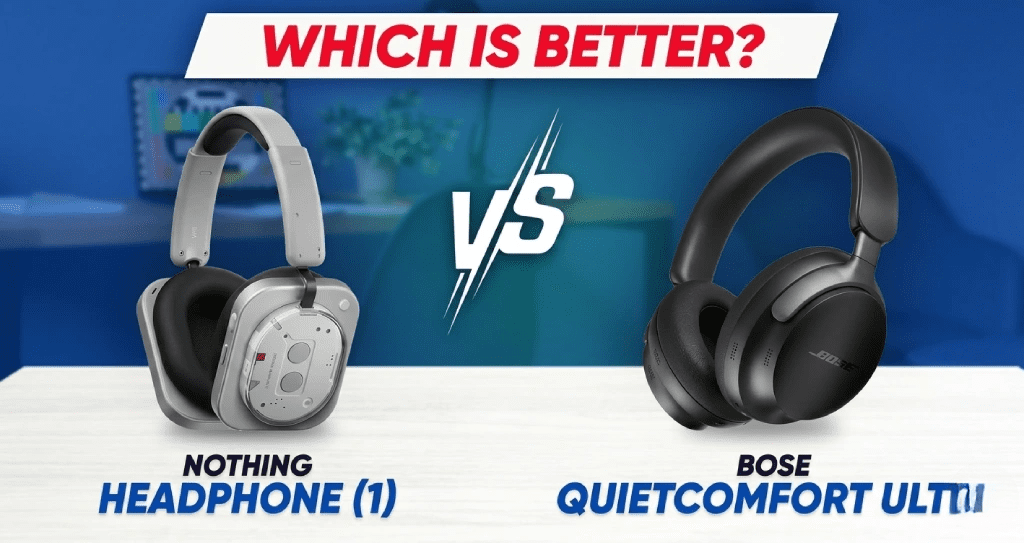
Nothing has always led with aesthetics, and the Headphone (1) is no exception. The semi-transparent earcups, exposed internals, and minimalist red accents make these one of the most visually distinctive headphones released in recent years. The build uses a mix of recycled plastic and aluminium, which feels solid without being heavy.
Bose takes the opposite approach: clean, matte-finish ovals, no theatrics. The QuietComfort Ultra looks like headphones designed by someone who thought very hard and then removed everything unnecessary. That’s not a criticism; the build quality is exceptional. The stainless steel headband adjustment, the premium leatherette earpads, and the overall structural rigidity feel like a mature product that’s been iterated on many times.
If design matters to you, nothing wins the visual conversation. If you want something that disappears into professional settings without drawing stares, Bose is the safer call.
Sound Quality Comparison
This is where opinions genuinely diverge, and it’s worth being honest about what both headphones do.
The Nothing Headphone (1) delivers a surprisingly lively, fun-sounding signature. Bass is present but not bloated, mids are reasonably clear, and the LDAC codec support means Android users can get notably better wireless audio quality than with AAC. For a $199 headphone, the sound is impressive and borderline exceptional at that price tier.
The Bose QuietComfort Ultra sounds more… composed. The frequency response is tuned for fatigue-free listening over long sessions. Bass is controlled, the midrange is natural, and treble extension is smooth without becoming harsh. Add aptX Adaptive and Bose’s spatial audio implementation called Immersive Audio and you get a genuinely wide, dimensional soundstage that most competitors at this price can’t match.
Bottom line on sound: Nothing sounds great for the price. Bose sounds great, period. If you’re an audiophile or do a lot of critical listening, you’ll notice the difference. Casual listeners may not and that’s okay.
Noise Cancellation Performance
ANC is where Bose has historically lived, and the QuietComfort Ultra doesn’t disappoint. Bose’s CustomTune technology uses a microphone to analyse your ear canal shape and adjust the ANC profile in real time. In practice, this means it adapts to you specifically, not a generic user profile. Low-frequency noise plane engines, air conditioning, open offices gets suppressed with remarkable consistency.
Nothing’s ANC is adaptive and decent, but it sits a tier below. It handles consistent ambient noise well but struggles more with sudden noise changes and sharp, high-frequency sounds. For commuting or casual use, it’s more than acceptable. For long-haul flights or noisy coworking environments? The Bose is noticeably better.
If ANC is a priority, this is one area where the Bose price premium genuinely reflects real-world performance.
Comfort & Fit
Nothing’s Headphone (1) weighs 290g heavier than you might expect from looking at it. The oval earcups and moderate clamping force work well for medium listening sessions, but some users report fatigue over 2+ hour stretches.
The Bose QuietComfort Ultra, at 250g with memory foam pads and a self-adjusting headband, is engineered for extended wear. The “QuietComfort” name has always been partly about physical comfort, and that tradition continues here. These are one of the most comfortable over-ear headphones you can buy full stop.
For people who wear headphones all day, Bose wins this category without much debate.
Battery Life
This one tilts back toward Nothing. 40 hours with ANC enabled is a genuinely impressive figure that beats almost everything in the premium category. Bose offers 24 hours under similar conditions, still solid, but clearly shorter.
For daily commuters or office users, the difference may be irrelevant. For travellers or remote workers who go days without a charger? The Nothing Headphone (1) has a meaningful practical advantage here.
Both support USB-C charging and offer a wired 3.5mm audio fallback if the battery dies completely.
Smart Features & App Experience
The Nothing X app has matured considerably. It offers EQ customisation, ANC transparency mode toggling, gesture controls, and firmware updates. The UI reflects Nothing’s design sensibility, minimal and clean. LDAC support and multipoint Bluetooth are both present and reliable.
The Bose Music app is one of the most polished audio companion apps available. Customisable EQ, Quiet Mode and Aware Mode sliders, shortcut button remapping, sleep timer, and the Immersive Audio spatial engine are all well-implemented. The app has years of refinement behind it and shows.
Both apps are good. Bose’s is more feature-complete; Nothing’s is more visually consistent. Neither will frustrate you, but Bose pulls ahead in depth.
Price & Value For Money
At ~$199, the Nothing Headphone (1) offers a remarkable package: strong sound, good ANC, LDAC support, 40-hour battery, and head-turning design. For budget-conscious buyers or those stepping up from entry-level options, it’s one of the best values in the market right now.
At ~$429, the Bose QuietComfort Ultra is still priced at the premium tier, but you’re paying for best-in-class ANC, class-leading comfort, a mature software ecosystem, and Bose’s proven track record. For professionals, frequent travellers, or audiophiles, it’s a justifiable investment.
Value for money technically goes to Nothing. Real-world premium performance goes to Bose.
Final Verdict
| Choose Nothing Headphone (1) if… | Choose Bose QuietComfort Ultra if… |
|---|---|
| Budget is a genuine considerationYou love distinctive designAndroid/LDAC audio quality mattersLong battery life is a priorityGood (not best) ANC is fine | You travel frequentlyAll-day comfort is non-negotiableYou want polished spatial audioYou need serious noise cancellationYou want a headphone that lasts 5+ years |
There’s no bad choice here. But if forced to pick one for the average person who wants a premium headphone they’ll use daily and won’t regret: the Bose QuietComfort Ultra earns its price. If you’re getting into the premium tier for the first time and don’t want to spend $400+, the Nothing Headphone (1) is the smartest buy at its price point today.
FAQ’s
Are Nothing Headphones (1) good for travel?
They’re solid travel headphones with good ANC and excellent battery life. For occasional travel, they’re more than adequate. Frequent flyers who prioritise serious noise isolation would still benefit from stepping up to Bose.
Does Bose QuietComfort Ultra support LDAC?
No, Bose uses aptX Adaptive instead of LDAC. For Android users prioritising highest-quality Bluetooth audio, this matters. For iPhone users, both headphones are essentially limited to AAC anyway.
Which headphones are more comfortable for long sessions?
The Bose QuietComfort Ultra. Its memory foam earpads, lighter weight (250g), and ergonomic headband design make it the better option for 4-8 hour listening sessions.
Is the Bose QuietComfort Ultra worth $200 more than the Nothing Headphone (1)?
It depends entirely on your use case. If ANC quality, comfort, and app ecosystem depth matter, yes the premium is justified. If you’re a casual listener or primarily use headphones at home, Nothing delivers 80% of the experience at half the price.
Can both headphones connect to multiple devices simultaneously?
Yes. Both the Nothing Headphone (1) and Bose QuietComfort Ultra support multipoint Bluetooth, allowing you to switch between two connected devices without manually re-pairing.
| Ready to Buy? Check Current Prices FirstPrices shift frequently especially on headphones. Before committing, check live pricing on Amazon, B&H, or the brands’ official stores. The Nothing Headphone (1) occasionally goes on sale well below $199, and Bose frequently runs promotions that make the QuietComfort Ultra significantly more accessible. A $50–$80 discount on the Bose changes the value equation considerably.Don’t rush the decision. Read verified buyer reviews, check return policies, and — if possible — try them in-store before purchasing. Your ears are the only benchmark that actually matters. |
For more budget headphone comparisons, visit BigBuys.net