Topping D900 Sound Quality Review: Clean, Neutral, or Clinical?
When you consider the Topping D900, you are looking at a serious investment $1,799 is not a casual purchase for most homeowners. At this level, it is natural to expect that every dollar should translate into a real, audible improvement. While the technical specifications are impressive on paper, what truly matters is how the D900 performs in your living room, during those long evenings with your favorite music. The real question is whether this level of technical precision actually delivers a sound you will enjoy, not just admire.
The honest answer takes a bit of unpacking.
What The Topping D900 Actually Sounds Like
The D900 is built around Topping’s own PSRM technology, which stands for Precision Stream Reconstruction Matrix. Rather than relying on the usual ESS or AKM chips found in nearly every other DAC at this price, Topping designed their own discrete 1-bit conversion system from scratch. The result is a noise floor so low it barely registers and distortion figures that most amplifiers cannot even measure accurately.
But specifications describe a ceiling, not a sound. The character of the D900 in actual listening is best described as truthful. It does not add warmth. It does not add sparkle. It does not apply any tonal polish over the top of a recording. What you hear is extremely close to what the recording engineer actually put on the file, which is either exactly what you want or the source of a certain frustration, depending on your library and your expectations.
Treble comes through extended and smooth without the grain that shows up in cheaper delta-sigma implementations. Cymbal decay is natural rather than truncated. Vocals sit at a realistic distance rather than being pushed forward for flattery. The bass is tight and textured with no added bloom, which suits acoustic double bass and well-produced electronic music equally well.
Why Some Listeners Find It Harsh
A recurring observation from people who have spent real time with the D900 is that certain recordings feel harder to listen to than expected. Vocals occasionally take on a slightly forward, sibilant quality. Snare hits can feel a bit punishing. Guitar tones on compressed modern recordings sometimes lose a layer of nuance.
This is not the DAC misbehaving. It is the DAC working exactly as designed. The D900 has no built-in mechanism for softening transients or rounding off the leading edges of sounds the way warmer-voiced equipment does. If a recording was mastered with aggression, if a vocal track has sibilance baked into the mix, if a song was pushed through the loudness wars without mercy, the D900 will present all of that with full clarity.
The listeners who run into this frustration are usually pairing the D900 with an amplifier or headphones that also lean toward the analytical side of the spectrum. In those chains, the transparency stacks rather than balances. The solution is not to return the DAC. It is time to reconsider the pairing. A warmer amplifier, something with a fuller lower midrange character, tends to complement the D900 very naturally.
The Musicality Question
A genuine debate exists in the audiophile community about whether a DAC this technically controlled can also be emotionally engaging. The argument is familiar: perfection removes the pleasant imperfections that make recorded music feel alive.
The D900 challenges that assumption rather than confirming it. With well-recorded material, classical chamber music, properly mastered jazz, and acoustic recordings with real room sound, the D900 produces a soundstage that feels genuinely three-dimensional. Imaging is specific without feeling artificially precise. Detail retrieval is exceptional in a way that reveals things in familiar recordings rather than simply making them louder or sharper.
The experience changes meaningfully depending on what you play. A beautifully produced hi-res recording through the D900 is genuinely moving. A heavily compressed pop track at 192kbps is exactly as flat as it deserves to be. That is not coldness. That is the recording being held accountable.
DSD Playback And One Thing Worth Knowing Before You Buy
Owners who use the D900 with high-resolution DSD files, particularly DSD256 and DSD512 through HQPlayer, sometimes notice a faint tick between tracks during playback. This has been confirmed as an inherent characteristic of the architecture when handling native DSD at extreme resolutions and is not a defect in any individual unit. PCM playback is completely unaffected.
Topping has addressed more significant popping that occurred during format switching through firmware updates, and that issue is largely resolved. The faint DSD tick is something to be aware of if DSD is your primary format, though most users find it inaudible at normal listening levels.
The Only RCA Output On The D900 Is The One You Bring Yourself
The D900 outputs exclusively through balanced XLR connections. There are two output pairs, one fixed level and one variable through the onboard active analog preamp, and that is it. No RCA jacks.
For most modern setups, this is perfectly fine. But for anyone running an OTL tube amplifier or an older integrated without balanced inputs, an XLR to RCA adapter becomes necessary. The important thing when using such an adapter is to ensure pin 3 of the XLR is connected to ground rather than left floating. An adapter that leaves pin 3 open can introduce hum or phase problems. A properly wired cable from a reliable brand solves this entirely.
How It Compares To The D90 III Discrete
The D90 III Discrete costs $800 less and uses an earlier version of Topping’s discrete conversion technology. Listeners who have spent time with both describe the D900 as sounding more natural and slightly less forward in the upper frequencies. The D90 III Discrete is genuinely excellent, but it carries a touch more brightness in direct comparison.
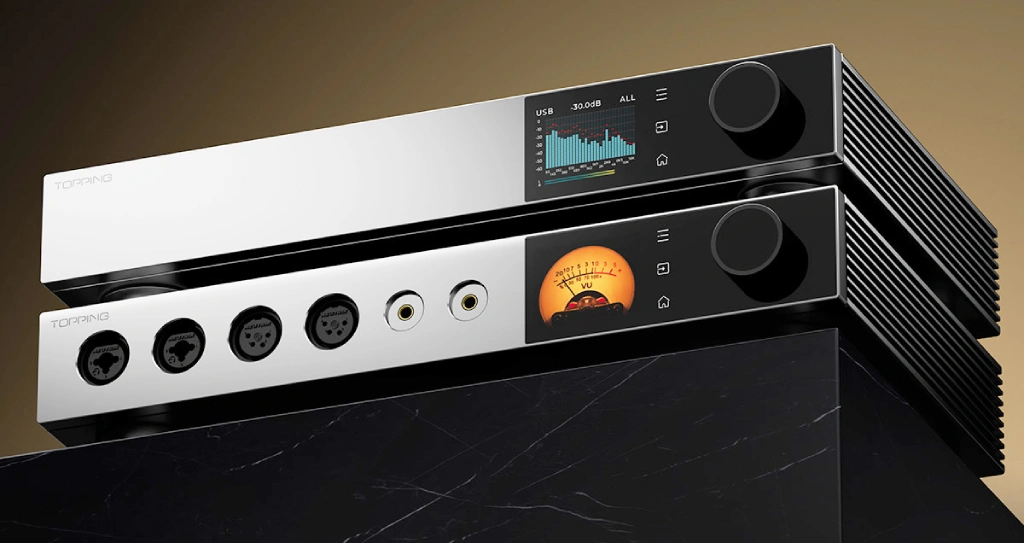
The D900 also includes a full active analog preamp stage with relay-controlled volume stepping in 0.5dB increments. This is not a passive attenuator or a digital volume control. It is a proper active circuit that allows the D900 to connect directly to a power amplifier or active speakers without a separate preamp in the chain. For a system built around that configuration, the preamp stage alone changes the value calculation significantly.
The 10-band PEQ built into the D900 also gives owners a meaningful tool for fine-tuning the presentation without altering the fundamental signal path. Those who find certain recordings slightly edgy have used gentle high-shelf adjustments to bring things into a more comfortable place without losing the resolution that makes the DAC worth owning.
Who Gets The Most From This DAC
The D900 rewards listeners who have good source material. High-resolution files, lossless streaming from platforms like Tidal or Apple Music, and a well-set-up CD transport; these give the DAC something real to work with, and the results are consistently impressive. Those building a balanced XLR signal chain from source to speaker will hear the full benefit of what the D900 offers.
It is less satisfying as a solution for listeners hoping the DAC will compensate for brightness elsewhere in their system or improve the sound of poorly mastered content. That is simply not what it does. Pairing it thoughtfully with a warm-leaning amplifier and quality recordings produces a result that genuinely competes with DACs at several times the price. Building the right audio chain around quality components makes a real difference across every listening session, and the D900 serves as an excellent foundation for anyone willing to invest in the complete picture. If you are thinking about upgrading your wider electronics setup alongside your audio system, exploring how the right components work together is a useful starting point.
Final Thoughts On The Sound Signature
Calling the Topping D900 clinical misses what it actually does. Clinical implies a lack of engagement, a sound that gets in the way of enjoyment. The D900 does not get in the way at all. It simply removes itself from the conversation entirely and lets the recording speak. On great recordings that is one of the best listening experiences available at this price. On poor recordings it offers no comfort.
Whether that is a virtue or a limitation depends entirely on what you listen to, how you listen, and what you are willing to adjust in your signal chain to work with it. For the right listener in the right system, the D900 is not cold. It is just completely, refreshingly honest.
FAQ
Is the Topping D900 good for long listening sessions? With well-mastered recordings and a balanced amplifier pairing, the D900 is comfortable over extended listening. The fatigue some users report typically comes from poorly matched amplifiers or analytical headphones rather than the DAC itself.
Does the Topping D900 work without an external preamp? Yes. The built-in active analog preamp allows direct connection to power amplifiers and active speakers. It uses relay-switched volume control in precise 0.5dB steps rather than a digital attenuator.
Why does the D900 sound harsh on some songs? The D900 does not add harshness. It reveals it. Songs with aggressive mastering, compressed dynamics, or sibilant vocal recordings will sound exactly as they were made. A warmer amplifier in the chain helps balance this without compromising the DAC’s core resolution.
Is the Topping D900 better than an R2R DAC? It is different. R2R designs typically add a warmer, more harmonically textured character. The D900 offers superior measured performance and greater transparency. The preference between the two comes down to whether you value accuracy or tonal richness more in your system.
Does the D900 have Bluetooth support? Yes. The D900 includes Bluetooth 5.1 with LDAC, aptX Adaptive, and aptX HD support, allowing wireless high-resolution streaming when needed.