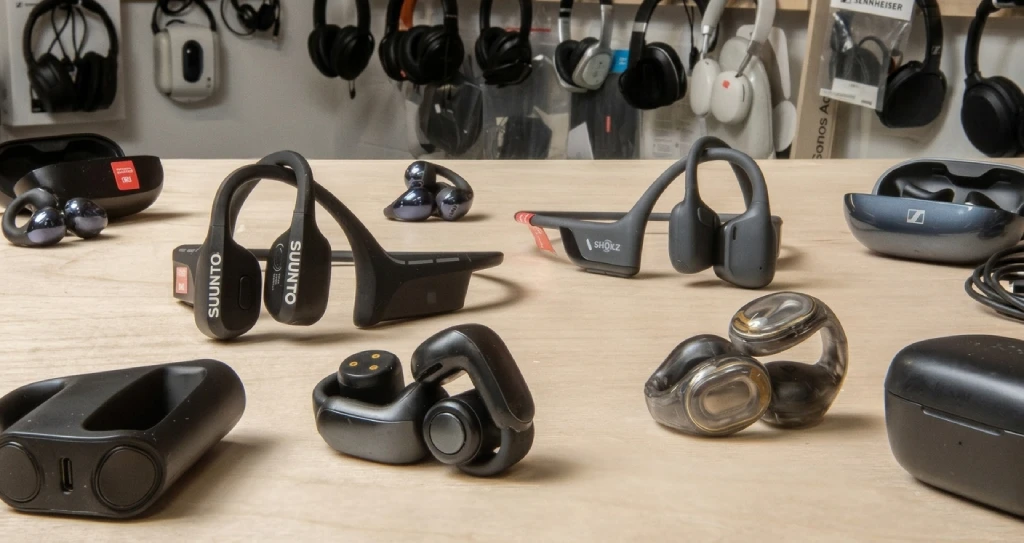
For decades, the best headphones were the ones that blocked everything out. Now the industry is betting on the opposite and buyers are following.
A few years ago, if you told someone you preferred headphones that let in outside noise, they’d probably assume your ANC wasn’t working. Today, that preference has an entire product category built around it, a packed CES showcase floor, and a growing list of converts who say they’ll never go back to in-ear tips.
What Actually Are Open-Ear Headphones?
The term covers a few different designs that share one key characteristic: your ear canal stays open. Nothing is pushed inside, nothing creates a seal. Sound reaches you through the air around your ear, through vibration via your cheekbones, or through a combination of both — but the outside world stays audible throughout.
There are three main types doing the rounds right now:
| Type | How it works | Best for |
|---|---|---|
| Air conduction (clip/hook) | Tiny speaker sits just outside the ear canal, aimed inward | Daily commute, office, casual listening |
| Bone conduction | Pads rest on cheekbones and send vibrations directly to the cochlea | Running, cycling, swimming |
| Ear cuff / clip-on | Clips onto the outer ear like jewelry; speaker faces the ear | Style-conscious users, light activity |
Why Now? The Shift That Changed Everything
Noise-cancelling technology reached its peak in the early 2020s. Brands like Sony, Bose, and Apple competed aggressively on ANC, and they won the best in-ears today genuinely block out the world. Which is exactly when a significant chunk of users started asking whether that was actually what they wanted.
Open-ear designs solved all of that without asking users to give up wireless audio entirely. The timing, combined with improvements in driver technology that dramatically closed the sound quality gap, made the category genuinely viable at scale.
“The best headphones used to be the ones that blocked everything out. Now the best ones let the world back in — on your terms.”
Sound Quality Issues Are Finally Mostly Solved
Here’s the honest history: early open-ear headphones sounded thin. Bass in particular suffered badly, because bass frequencies need some degree of air pressure and containment to be felt and heard properly. A speaker floating outside your ear canal, no seal, room acoustics everywhere it wasn’t a recipe for low-end punch.
The result: open-ear headphones in 2026 can produce genuinely full-bodied audio that would have been implausible from the same form factor three years ago. They still don’t match a premium sealed ANC earbud in raw audio performance — that gap hasn’t fully closed — but for everyday listening, the difference has become a reasonable trade-off rather than a glaring compromise.
Quick stat
The open-ear segment has gone from a niche running category to one of the most competitive shelves in consumer audio with JBL alone launching three new open-ear models at CES 2026, and virtually every major audio brand now maintaining at least one open-ear line.
Who’s Actually Buying Them
office and remote workers. The pandemic changed how people work, and a significant portion of the workforce now spends the day in hybrid setups — some hours in meetings, some in deep focus, some in shared spaces. Open-ear headphones let them listen to music or audio without disappearing from their environment, which matters when coworkers walk over without warning or a child needs attention.
commuters and urban cyclists who view ambient awareness as a safety feature, not an inconvenience. This group tends to be highly loyal once you’ve ridden a city bike without being able to hear a car horn, you don’t go back to sealed earbuds for outdoor use.
What’s Next For The Category
The direction of travel is clear. Every major audio brand now has at least one open-ear product, and the design experimentation on display at CES 2026 ear cuffs, shape-shifting frames, hybrid designs that sit somewhere between a clip and a traditional earbud suggests the category is nowhere near its final form.
Battery life is also improving faster than it did with traditional earbuds. Several current models already hit 10-12 hours of continuous playback with cases that extend total life to 50 hours or beyond. For a category that partly sells itself on effortless all-day wear, battery anxiety is becoming increasingly irrelevant.
THE BOTTOM LINE
Open-ear headphones aren’t a trend that snuck up on the audio industry. They’re the product of a clear shift in how people actually use audio in their daily lives — and a category that spent years quietly getting good enough to go mainstream. The brands that understood this early, like Shokz, built loyal audiences. The brands catching up now, like JBL and Sony, are moving fast. For anyone who’s never tried them: 2026 is the best time to find out what the noise is about.
FAQ’s
What are open-ear headphones?
Open-ear headphones are audio devices designed to let you hear music while still staying aware of your surroundings.
How do open-ear headphones work?
Most open-ear headphones use bone conduction or air conduction technology to deliver sound without sealing the ears.
What is the difference between bone conduction and open-ear headphones?
Bone conduction is one type of open-ear technology that sends vibrations through the cheekbones. However, not all open-ear headphones use bone conduction; some use directional speakers near the ears.
Who should use open-ear headphones?
They are ideal for runners, cyclists, commuters, office workers, and anyone who wants to stay aware of their environment while listening to audio.