
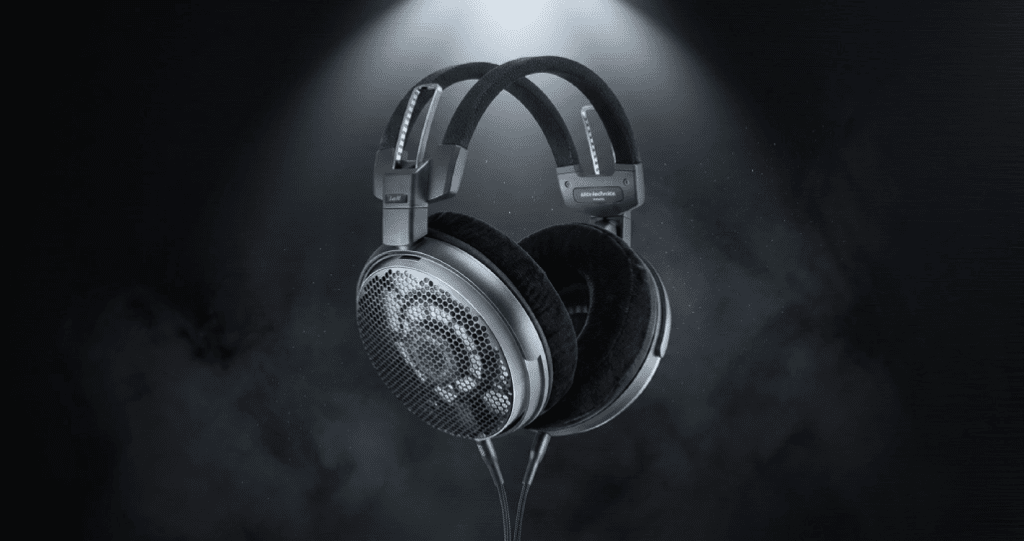
Two flagship open-backs. Two very different philosophies. One decision.
If you’ve made it to this comparison, you’re already playing in the deep end of the audiophile pool. The Audio-Technica ATH-ADX7000 vs. Sennheiser HD800S debate isn’t about which headphone is better. They’re both exceptional. It’s about which kind of exceptional matches your ears, your music, and your setup.
Let’s break this down properly.
Quick Specs at a Glance
| Feature | Audio-Technica ATH-ADX7000 | Sennheiser HD 800 S |
| Type | Open-back dynamic | Open-back dynamic |
| Driver | 53mm Carbon Nanotube (CNT) | 56mm Ring Radiator |
| Frequency Response | 5Hz – 50kHz | 4Hz – 51kHz |
| Impedance | 40 ohms | 300 ohms |
| Sensitivity | 100 dB/mW | 102 dB/mW |
| Weight | ~200g | ~330g |
| Price Range | ~$2,000–$2,200 | ~$1,600–$1,800 |
| Cable | Detachable, balanced | Detachable, balanced |
| Origin | Japan | Germany |
The first thing you’ll notice is that the HD800S is nearly 70% heavier. That matters more than people admit during long listening sessions.
Sound Quality
ATH-ADX7000
The ADX7000’s Carbon Nanotube drivers are no gimmick. This headphone renders micro-detail in a way that sounds almost surgical, except it never feels cold. There’s a warmth embedded in the midrange that makes vocals feel like they’re inside the room with you rather than broadcast from a stage.
The bass is tight and fast, not particularly elevated, but extremely well-defined. If you’re a bass-head, look elsewhere. But if you listen to jazz, acoustic guitar, or well-recorded chamber music, the low-end control here is stunning. Plucked double bass strings don’t bloom into mush. They decay naturally and stop where they should.
The treble is extended and airy, but Audio-Technica has done something smart here: it sparkles without ever crossing into sibilance. You can listen for hours without the upper-frequency fatigue that plagues many hi-res-oriented headphones.
The soundstage is moderately wide. Intimate is actually the right word. It’s not a headphone that throws sound to the far corners of your imagination. It keeps things organized and close-in, which some listeners absolutely love.
Sennheiser HD 800 S
The HD800S has been the reference standard in open-back headphone design for over a decade, and there’s a reason for that. Its soundstage is genuinely unlike anything else at this price. It’s the headphone equivalent of sitting in the 10th row at Carnegie Hall. Instruments have physical space between them. Orchestral music, classical recordings, and anything with complex layering become a near-holographic experience.
The Ring Radiator driver produces coherence across the frequency range that’s almost eerie in its naturalness. The highs are famously extended, and some say ruthlessly so. Early versions of the HD800 were criticized as bright and unforgiving. The HD800S addressed this with added bass presence and a slightly warmer tonal balance. It’s better now, but it still rewards clean sources. Feed it a poorly mastered track, and it will tell you everything wrong with it.
The bass is elevated compared to the original HD800, but still not bass-heavy by any stretch. It’s accurate and impactful where the recording calls for it.
Comfort and Build
Audio-Technica clearly put serious thought into ergonomics with the ADX7000. At roughly 200 grams with a 3D wing support system, it practically disappears from your head. The ear cups are generously padded, and side pressure is minimal. Four-hour listening sessions don’t feel like endurance tests.
The HD800S is more substantial at 330 grams, sitting on a uniquely wide headband. The over-ear cups are enormous, designed to keep drivers away from your ears and eliminate ear fatigue. Some listeners find the clamping force less forgiving than the ATH, though. Both use premium materials. The HD800S feels more classically “high-end German engineering.” The ADX7000 feels more refined and modern.
Pros and Cons
ATH-ADX7000
Pros
- Featherweight comfort for extended sessions
- Exceptional midrange warmth and vocal presence
- Non-fatiguing treble despite hi-res extension
- Lower impedance, so more DAC/amp friendly
- Stunning micro-detail in instruments
Cons
- Narrower soundstage than HD800S
- Less impactful for large orchestral works
- Hard to find an in-store to audition
- Premium pricing without the pedigree recognition of HD800S
Sennheiser HD 800 S
Pros
- Legendary, room-filling soundstage
- Reference-grade imaging precision
- Decades of refinement and audiophile trust
- Excellent for classical, jazz, and acoustic genres
- Strong resale value
Cons
- Demanding of source quality and unforgiving of poor recordings
- Heavy and less comfortable for marathon sessions
- Requires a capable amp (300 ohms)
- Bright-leaning tonality isn’t for everyone
Who Should Buy Which?
Choose the ATH-ADX7000 if: You listen to vocals-forward music, think acoustic singer-songwriters, jazz quartets, solo piano, or intimate studio recordings. If you prefer a warmer, more personal presentation and hate headphone fatigue, the ADX7000 is built for you. It’s also the smarter pick if your amplification is modest or portable-friendly. People who want a headphone that feels like nothing on their head while still delivering world-class sound will love this.
Choose the Sennheiser HD 800 S if: You primarily listen to large-scale classical, symphonic, or progressive rock where spatial imaging is everything. If you already own a high-quality desktop amp and DAC, and your library is well-mastered, the HD800S will reward that investment in a way that’s hard to describe until you’ve heard it. It’s also the go-to for mixing engineers and mastering professionals who need spatial accuracy above all else.
If you’re exploring high-end open-back alternatives beyond these two, check out the GRELL OAE2 review. It’s a serious contender in this tier that often gets overlooked.
FAQ’s
Is the ATH-ADX7000 easier to drive than the HD800S?
Significantly. At 40 ohms, the ADX7000 works well with a quality portable DAC/amp. The HD800S at 300 ohms really needs a dedicated desktop amplifier to perform at its best. Don’t pair the Sennheiser with anything weak. It sounds flat and lifeless without proper power.
Does the HD800S still hold up in 2025?
Absolutely. It’s been updated since its original release and remains one of the clearest windows into a recording available at any price. Newer competitors have closed the gap, but no one has truly surpassed its soundstage-to-price ratio.
Which is better for gaming?
Neither is built for gaming, but if forced to choose, the HD800S wins on positional accuracy and soundstage width, which is useful for competitive gaming where spatial cues matter.
Can I use these headphones without an amp?
The ADX7000 can work without a dedicated amp in a pinch. The HD800S simply cannot. It will sound underpowered and dull from a phone or laptop headphone jack.
Final Verdict
These are two of the finest headphones made, and the “winner” depends entirely on you, not on any spec sheet.
The ATH-ADX7000 is the more holistic daily driver. It’s lighter, warmer, more forgiving of source quality, and delivers an intimacy with music that’s deeply satisfying. For most music genres and most listeners, it’s actually a more enjoyable experience.
The Sennheiser HD800S is the precision instrument. It reveals more about a recording’s spatial design than almost anything else you can buy. For classical, orchestral, and studio-quality listening, it remains a gold standard.
Bottom line: If you listen wide, meaning big compositions and sprawling arrangements, go HD800S. If you listen deep, meaning detail, warmth, and long sessions, go ATH-ADX7000.
Either way, at this level, the real question isn’t which one sounds better. It’s which one sounds better for you.



Leave feedback about this