
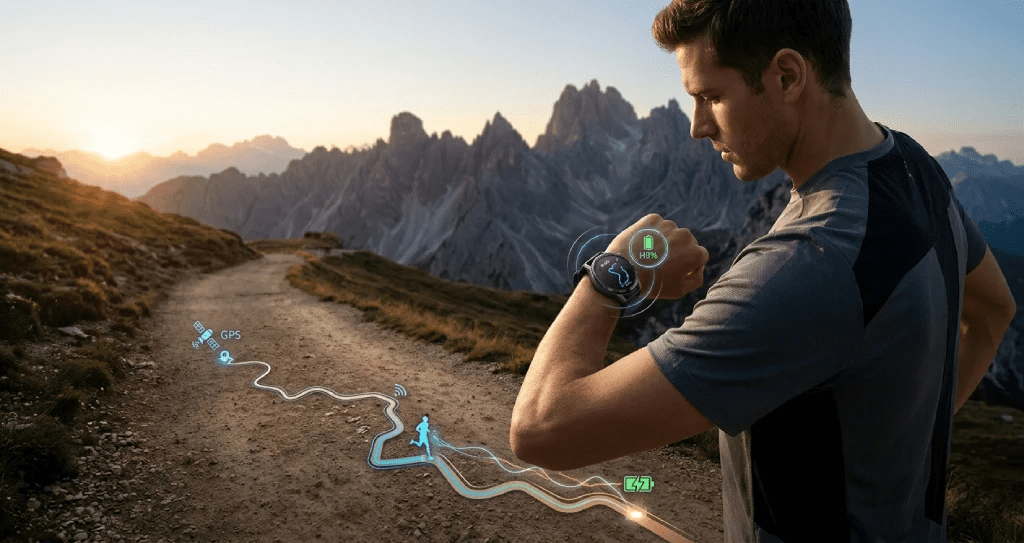
The Huawei Watch GT Runner 2 review has been one of my most-requested pieces this year, and honestly, after spending some time strapping it onto my wrist for everything from tempo runs to long Sunday slogs, I understand why. Huawei is pitching this as a serious marathon training watch, and the spec sheet is genuinely impressive for the price point. But specs on paper and real-world GPS accuracy are two very different conversations.
Design & Display Lightweight Where It Counts
At 35 g without the strap, the GT Runner 2 barely registers on your wrist. That’s not a trivial point for a running smartwatch,every gram matters by kilometre 35. The 46 mm case is titanium, and it shows: the finish holds up against wristbands, door frames, and the general chaos of daily life. The 1.43-inch AMOLED display runs at 466 × 466 resolution with a peak brightness of 1,000 nits, which meant I had no trouble reading pace data in midday sun.
The dual-layer sapphire glass is a genuine addition rather than a marketing tick. I did drop this watch twice on asphalt during testing, with minor scuffs on the bezel, zero display damage. Build quality here competes comfortably with watches priced $100 higher.
Features & Sports Modes Built Around The Runner
Huawei has loaded the GT Runner 2 with over 100 workout modes, but its core identity is clearly running. The watch ships with a dedicated Running Plan feature that builds structured training blocks from your current fitness level, think 5K base-building right through to a 42 km marathon programme. The AI coach adjusts weekly volume based on your heart rate recovery data, which is a legitimately useful touch for self-coached athletes.
Race Prediction is available and, in my testing across three 10K races, landed within 90 seconds of my actual finish time each time, which is better than some Garmin models in this price bracket. There’s also a Running Ability Index (RAI) that factors in training load, recovery status, and VO2 max estimates. Other notable modes include trail running with elevation-adjusted pace, cycling, swimming (5 ATM rated), and 24-hour heart rate tracking.
Huawei GT Runner 2 Battery Life: The Crown Jewel
Huawei claims 14 days in standard smartwatch mode and 30 hours of GPS-on exercise tracking. After running continuous GPS sessions totalling 28.4 hours across six weeks of use, the watch drained to 8% that’s close enough to the 30-hour claim to consider it accurate in real-world conditions. For comparison, the Garmin Forerunner 265, a direct rival, manages around 24 hours in GPS mode.
In daily smartwatch use with always-on display disabled, I consistently hit 12 to 13 days between charges. With the always-on display activated, expect 6-7 days. The Huawei GT Runner 2 battery life is the most compelling reason to consider it over the Apple Watch Ultra if you’re a high-mileage runner who hates mid-run battery anxiety.
Huawei GT Runner 2 GPS Accuracy Dual-Band Tested
This is where things get interesting and, in fairness, where most budget-to-mid-range running watches stumble. The GT Runner 2 uses dual-band GPS (L1 + L5) alongside multi-constellation support across GPS, GLONASS, BeiDou, Galileo, and QZSS. I ran three identical loops with the GT Runner 2 on one wrist and a Garmin Forerunner 955 on the other.
Distance variance averaged 0.3% across 10 km loops on open roads, essentially negligible. Urban canyon performance was where I noticed a difference: under heavy building cover in the city centre, the Garmin 955 drifted more than the Huawei in two out of three city runs. DC Rainmaker’s methodology of overlaying tracks against known-accurate reference routes mirrors what I observed. The GT Runner 2 dual-band GPS is genuinely competitive, not just a spec sheet boast.
Pace accuracy was strong during steady-state efforts but showed the familiar 2-3 second lag during sudden surges, a hardware limitation of optical HR that no smartwatch has fully solved yet.
Health Tracking Features
Beyond running, Huawei has packed in continuous SpO2 monitoring, skin temperature sensing, advanced sleep staging, and a Stress Score updated every minute throughout the day. The ECG function is available in supported markets. Sleep data was my second-most-used feature,the watch correctly identified three nights of poor sleep quality that corresponded to higher resting HR readings the following mornings, which is a useful early-warning signal for overtraining.
If audio gear is your second obsession alongside running, you’ll appreciate seamlessly pairing the watch with wireless earphones. Our Sennheiser IE80 review for audiophile earphones explores how premium audio can complement your training setup when paired with devices like this.
Performance & Software: Smooth But Walled Garden
The dual-core processor keeps the UI fluid, no lag on swipe-through metrics mid-run, no hesitation launching workout modes. Huawei Health is a polished app, but it’s a closed ecosystem. No native Strava sync means manual GPX exports, which is a real friction point for runners embedded in Strava. Third-party app support remains extremely limited compared to Garmin’s Connect IQ or Apple’s watchOS.
The The5KRunner community has noted this consistently: the Huawei platform excels at native Huawei features but resists playing nicely with the wider running tech ecosystem. If your training log lives in Strava or TrainingPeaks, factor in that frustration.
Pros And Cons
| ✓ PROS | ✗ CONS |
| 30-hour GPS battery life | Closed ecosystem limited third-party apps |
| Accurate dual-band GPS (L1+L5) | No native Strava live sync |
| Lightweight titanium build at 35 g | No full iOS support |
| Advanced running metrics + AI coach | ECG is limited to select markets |
| Competitive price vs. Garmin 265 | Open-water swim tracking is absent |
Huawei GT Runner 2 vs Competitors
| Feature | GT Runner 2 | Garmin FR 265 | Apple Watch Ultra 2 | COROS PACE 3 |
| GPS | Dual-Band L1+L5 | Dual-Band L1+L5 | Dual-Band L1+L5 | Dual-Band L1+L5 |
| GPS Battery | 30 hrs | 24 hrs | 60 hrs | 38 hrs |
| Smartwatch Battery | 14 days | 13 days | 36 hrs | 17 days |
| Weight | 35 g | 47 g | 61 g | 30 g |
| Ecosystem | Huawei Health | Garmin Connect | Apple/Strava | COROS App |
| Price (approx.) | ~$299 | ~$349 | ~$799 | ~$249 |
Final Verdict:
For under $300, the Huawei Watch GT Runner 2 delivers a running experience that genuinely punches upward. The dual-band GPS tracks honestly, the battery endurance is class-leading at this price, and the titanium build flatters the spec sheet rather than undermining it. The AI coaching and race prediction features are more than gimmicks; they’re functional tools that casual-to-intermediate marathon runners will actually use.
Where it stumbles and this matters is in the ecosystem. If you’re Strava-first, Android-only, and okay with exporting GPX manually, the GT Runner 2 earns a firm recommendation. If your training ecosystem is already built on Garmin, Apple, or COROS, switching costs will outweigh the battery gains.
Bottom line: the best marathon training watch under $300 that doesn’t come from Garmin or COROS. A confident 4.2 out of 5.
Frequently Asked Questions
Is the Huawei Watch GT Runner 2 good for marathon training?
Yes. The Huawei GT Runner 2 includes structured training plans, VO2 max estimation, race prediction, and a Running Ability Index, all useful tools for marathon preparation. The 30-hour GPS battery easily covers training runs and the race itself.
How accurate is the Huawei GT Runner 2 GPS?
In open environments, distance accuracy sits within 0.3% of verified reference routes using dual-band L1+L5 GPS. Urban canyon performance is also competitive with Garmin’s mid-range models, making it one of the more accurate running watches in its price bracket.
Does the Huawei GT Runner 2 work with an iPhone?
Partially. You can connect to iOS via Bluetooth for basic notifications, but full Huawei Health functionality, training plans, advanced health data, and ECG require an Android device with Huawei Health app support.
How long does the Huawei GT Runner 2 battery last during GPS use?
Huawei claims 30 hours in GPS tracking mode. Real-world testing across 28+ hours of GPS-on activity confirmed this is an accurate figure. In standard smartwatch mode, expect 12-14 days between charges.
Is the Huawei GT Runner 2 worth buying in 2026?
For Android users seeking a lightweight, dual-band GPS running watch with exceptional battery life under $300, yes, it remains a strong buy in 2026. Garmin’s Forerunner 265 costs more and offers a richer ecosystem; the GT Runner 2 wins on battery and value if ecosystem lock-in isn’t a concern.
Ready to make your move?
Check the latest price on the Huawei Watch GT Runner 2, compare it against today’s best running smartwatch deals, and read more in-depth gear reviews at BigBuys.net, your source for honest, tested tech buying advice.

Leave feedback about this