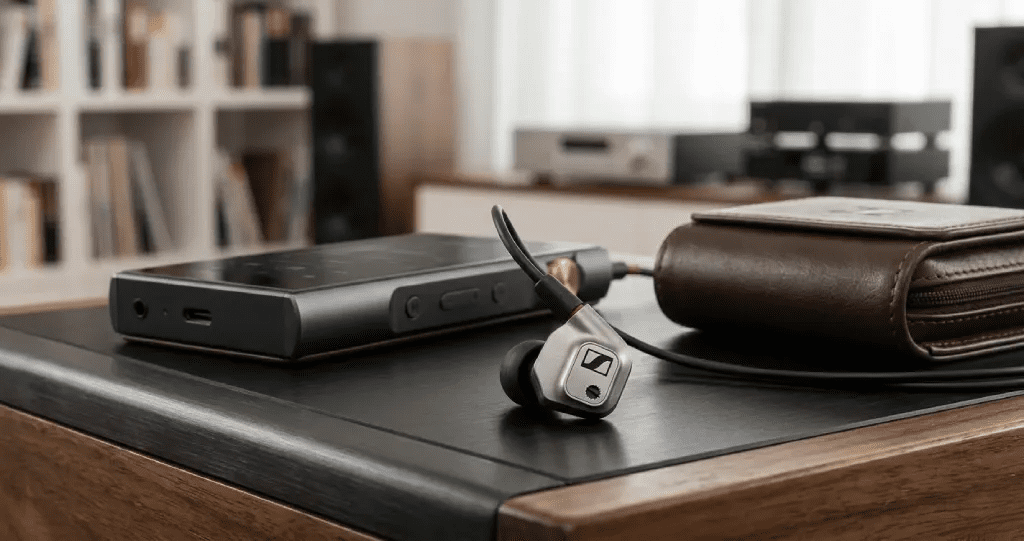
There’s a reason the Sennheiser IE80 review still gets written in 2026 nearly 15 years after the earphone first launched. Some products become reference points, and the IE80 is exactly that. A benchmark for warm, wide, natural sound from a single dynamic driver that most modern earphones are still trying to beat.
Whether you stumbled on a mint pair second-hand or you’re debating the original IE80 against its updated sibling, the IE80S, this review covers everything that matters: real sound impressions, the bass dial explained properly, comfort for long sessions, and who this earphone is actually built for.
Sennheiser IE80 Overview
Released in 2011, the Sennheiser IE80 sat at the upper end of Sennheiser’s consumer IEM range, the IE line alongside the flagship IE800. At $249 on launch, it positioned itself as a serious audiophile tool rather than a casual listening earphone. The core proposition? A large, custom dynamic driver with an adjustable bass resonator, engineered to give listeners genuine control over their low-end signature.
Sennheiser replaced it with the IE80S in late 2017, tightening bass control and reducing the veil on midrange clarity. However, the original IE80 remains widely used and respected on the used market, often available at prices that make it a compelling buy even today.
Design & Build Quality
The IE80’s housing is a blend of high-grade plastic and subtle metal accents understated rather than flashy. It has an over-ear cable routing design; the cable wraps around your ears for secure wearing, which takes about 20 seconds to get right but becomes second nature quickly.
The build feels solid without being heavy. The housings do not flex, the strain reliefs are well-reinforced, and the cable itself holds up to daily use without excessive tangling. The one legitimate complaint on the original IE80: the cable is not detachable. The IE80S corrected this with an updated MMCX connection on some variants.
The included carry case, a semi-hard zipper case approximately 6″ x 4″ is large but practical. It comfortably holds the IEM alongside a small DAP or portable amplifier, which is a genuinely thoughtful design for the audiophile who carries a listening stack.
Sennheiser IE80 Sound Quality
Bass
The IE80’s bass is its most discussed feature and rightly so. Set at a neutral position, the low end is full and textured with a slight warmth in the upper bass that gives kick drums and bass guitar a satisfying weight. Turn the dial up, and the bass becomes genuinely powerful not muddy, but unmistakably large. At maximum, sub-bass reach is impressive for a single dynamic driver. Hip-hop, electronic, and orchestral tracks all benefit from this tuning.
The only trade-off: that upper-bass emphasis at higher dial settings does nudge vocals slightly back in the mix. It’s not a dealbreaker but if you primarily listen to jazz vocals or acoustic guitar, you may prefer the dial at its minimum.
Midrange
Mids on the IE80 are smooth and natural. They carry a warm tint that makes male vocals feel rich and intimate. Female vocals are present but slightly less forward than on a neutral tuning earphone. Instruments in the midrange guitar, piano, strings have excellent timbre. Nothing sounds artificially sharp or sibilant.
Treble
Treble is polished and controlled. It extends well without harshness, keeping the overall signature on the warm side of balanced. Cymbal strikes are clean and present without being fatiguing over long sessions. Listeners who want sharp, airy treble should look at more analytical earphones; the IE80 is deliberately smooth up top.
Soundstage & Imaging
This is where the IE80 genuinely earns its reputation. The soundstage is wide, notably wider than most earphones in or above its price range. Instruments sit with clear separation and a sense of depth that makes even busy orchestral passages feel unhurried. Binaural recordings and well-mastered rock albums in particular sound almost speaker-like in their spatial rendering.
IE80 Adjustable Bass Feature How It Works
The bass adjustment screw is located on the back of each earphone housing. A small flathead screwdriver (or the included cleaning tool’s reverse end) rotates the dial. The range runs from minimum (tightest, most neutral) to maximum (most bass-heavy).
A practical guide for different music genres:
- Hip-hop / EDM: Set to 70–100% for maximum sub-bass impact
- Rock / Metal: Set to 40–60% for punchy but controlled low-end
- Jazz / Classical: Set to 10–30% for neutral, accurate staging
- Pop / R&B: Set to 50–70% for vocal warmth with bass presence
Both channels should be adjusted equally to mark your preferred setting on the housing if needed, since the dial position isn’t visually obvious once you’ve found your sweet spot.
Comfort & Fit
Comfort is excellent. The IE80’s housings are contoured to sit flush against the concha of the ear, and the over-ear cable routing keeps the earphones stable during movement. Silicone tips in small, medium, and large sizes are included, plus dual-flange and Comply foam options.
Foam tips in particular change the sonic character noticeably warmer and more sealed compared to silicone. Most listeners will find their ideal fit within the included options. Long listening sessions of two to three hours produce no fatigue.
Sennheiser IE80 Specifications
| Specification | Details |
| Driver Type | Dynamic (single driver) |
| Frequency Response | 10 Hz – 20,000 Hz |
| Impedance | 16 Ω |
| Sensitivity | 125 dB SPL (1 kHz / 1 Vrms) |
| THD | < 0.1% (1 kHz, 94 dB SPL) |
| Cable Length | 1.3 m (with in-line remote variant available) |
| Connector | 3.5 mm gold-plated stereo jack |
| Weight | 18 g (without cable) |
| Adjustable Bass | Yes (screw-dial on housing) |
| Ear Tips Included | Silicone (S/M/L), dual flange, Comply foam |
| Case Included | Yes – semi-hard zipper carry case |
| MSRP (Launch) | ~$249 USD |
Sennheiser IE80: Pros And Cons
| ✅ PROS | ❌ CONS |
| Warm, smooth, and exceptionally wide soundstage | Upper-bass bloom can veil midrange clarity |
| Adjustable bass dial for personal tuning | 3.5 mm cable is not detachable (original IE80) |
| Premium build quality with high-grade plastic and metal accents | Pricier than newer rivals at similar tuning |
| Comfortable fit for extended listening sessions | Treble can feel slightly reserved for brightness lovers |
| Bundled with multiple ear-tip options + carry case | |
| Low 16Ω impedance drives easily from smartphones |
Who Should Buy The Sennheiser IE80?
The IE80 is the right earphone if you:
- Prefer warm, natural tuning
- over bright or analytical sound signatures
- Listen to genres that reward wide soundstage
- jazz, orchestral, rock, hip-hop
- Want adjustable bass
- without swapping cables or using EQ apps
- Are buying used
- and want a proven, reliable earphone at sub-$150 pricing
Avoid the IE80 if you need a detachable cable, want crisp treble-forward sound, or are spending new-market prices at $200+, newer competition offers more features. But on the secondary market at $80–130? The IE80 is genuinely hard to beat.
If your budget is tighter, our Meze ASTRU review walks through a compelling budget audiophile alternative worth considering before you commit.
Sennheiser IE80 vs Meze ASTRU: Which Should You Choose?
The Meze ASTRU is a modern budget audiophile earphone that frequently gets recommended alongside the IE80 for listeners entering the hi-fi space. Here’s how they compare directly:
| Feature | Sennheiser IE80 | Meze ASTRU |
| Driver Type | 1DD (Dynamic) | 1DD (Dynamic) |
| Frequency Response | 10–20,000 Hz | 20–20,000 Hz |
| Impedance | 16 Ω | 32 Ω |
| Soundstage | Very Wide | Moderate |
| Bass Adjustment | Yes (dial) | No |
| Detachable Cable | No (original IE80) | Yes (MMCX) |
| Warm Tuning | Yes | Mild V-shape |
| Price Range | ~$180–250 (used/new) | ~$39–49 |
| Best For | Audiophile warm listening | Budget entry hi-fi |
Verdict on the comparison: the IE80 wins on soundstage width, bass customization, and low-end texture. The Meze ASTRU wins on cable modularity, price accessibility, and overall value for a first hi-fi earphone. If you’re new to audiophile listening and not sure about warm tuning, the ASTRU is a lower-risk entry point. If you already know you love warmth and space, save up for the IE80.
Final Verdict Sennheiser IE80 Review
The Sennheiser IE80 is not a perfect earphone. Its midrange can feel slightly veiled when the bass is dialled up, the original cable is not detachable, and newer options have caught up in many technical areas. But none of that changes what it does uniquely well: it creates a soundstage that feels genuinely open, a warmth that flatters almost every genre, and a low-end flexibility that no other earphone in its price history has matched so intuitively.
For music lovers who value how a recording feels over how technically dissected it sounds the IE80 is still, in 2026, one of the most satisfying earphones you can put in your ears.
Frequently Asked Questions (FAQ)
Q1: Is the Sennheiser IE80 still worth buying in 2026?
Yes if you prefer a warm, wide-sounding signature over analytical precision, the IE80 remains a compelling choice. Its soundstage depth is still difficult to match at any price point among single-driver IEMs.
Q2: What is the difference between IE80 and IE80S?
The IE80S (2017) tightened the bass slightly and reduced the upper-bass bloom that veiled the IE80’s midrange. Both share the same driver housing and adjustable bass dial, but the IE80S has a smoother, more controlled low end.
Q3: Does the IE80 bass dial make a noticeable difference?
Absolutely. Rotating the dial from min to max adds roughly 3–5 dB of sub-bass. At minimum, the sound is tighter and more mid-forward; at maximum, it becomes noticeably warm and bass-heavy, excellent for hip-hop and electronic music.
Q4: Can you use the IE80 without an amplifier?
Yes. At 16Ω and 125 dB sensitivity, the IE80 drives cleanly from any smartphone or DAP without needing a dedicated amplifier.
Q5: How does the IE80 compare to budget audiophile options?
The IE80 offers a noticeably wider soundstage and more refined low-end texture than budget competitors like the Meze ASTRU, though the ASTRU wins on cable modularity and price-to-performance for newcomers to hi-fi listening.