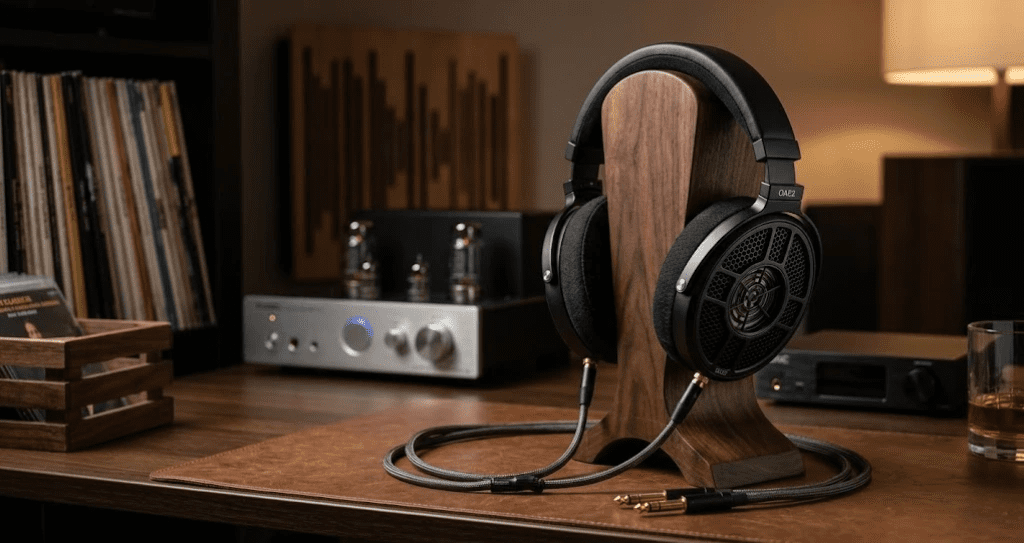
Most open-back headphones promise a wide, airy soundstage. The Grell OAE2 delivers one and then some. If you’ve been undecided about whether this headphone deserves a spot in your rotation, this Grell OAE2 review covers everything from unboxing to long, late-night listening sessions.
First Impressions & Build Quality
Picking up the OAE2 for the first time, you notice it doesn’t try to look flashy. The design is restrained, almost understated, with a lightweight frame between industrial and refined. The ear cups have a brushed-metal finish that doesn’t feel cold or cheap, and the headband padding hits a comfortable sweet spot that doesn’t crush your skull after an hour.
The grille design is open as expected, and the cable terminates cleanly. Nothing rattles or flexes improperly. Ulf Grell, formerly of Sennheiser, clearly brought German engineering sensibility to the product. The OAE2 feels built for serious use, not a shelf display.
That said, a few pain points are worth calling out early. The clamp force out of the box is noticeably firm, enough to cause mild pressure on the temples during the first sessions. It eases up over time, but if you plan to dive into a three-hour listening session the day it arrives, you might adjust the fit more than you’d like. Also, the ear pads, while decent, heat up faster than expected in warmer weather. Not a dealbreaker but something to factor in.
Sound Performance:
Bass Response
The low end on the OAE2 is controlled, clean, and honest. It doesn’t carry the bass shelf boost that makes budget headphones sound exciting out of the box. What you get instead is tight, well-defined bass that extends meaningfully without bleeding into the mids. On bass-heavy electronic tracks, kick drums land with precision rather than boom, which audiophile listeners will appreciate but casual listeners might initially find flat.
This is one of the OAE2’s more polarizing aspects. Listeners coming from Beats, Sony consumer headphones, or anything with a V-shaped signature will feel the bass is genuinely lacking at first. It takes time to recalibrate your expectations. Once you do, you’ll realize the bass is actually there; it’s just not being exaggerated for you.
Midrange
This is where the OAE2 genuinely shines. Vocals feel natural and placed correctly in the mix, neither pushed forward aggressively nor recessed into the background. Acoustic guitars, piano runs, and string instruments carry genuine texture. There’s a tonal warmth here that doesn’t tip into color or overly smooth. It respects the recording without editorializing.
Treble
Treble extension is good, though the OAE2 leans toward smooth rather than bright. High-hat transients are crisp without ever becoming fatiguing. For listeners sensitive to upper treble spikes, this is a genuinely comfortable headphone for long sessions. Audiophiles chasing extreme air and sparkle in the upper register might want more, but anyone prioritizing long-term listenability will be satisfied.
Imaging & Soundstage
Spatial presentation is where the OAE2 earns serious attention. The soundstage is wide and convincingly three-dimensional for a headphone in this range. Instrument separation is precise. On complex orchestral passages, individual sections hold their positions clearly rather than blending into a sonic soup. Imaging shows a genuine left-right distinction with credible depth.
Compared to similarly priced competitors in the audiophile open-back space, the OAE2 punches above its weight in spatial accuracy. If you’ve been exploring earphones at a lower price point, like the Meze Astru, stepping up to the OAE2 reveals a noticeably wider soundstage and more refined layering.
Comfort & Everyday Wearability
Long listening sessions are where comfort separates good headphones from great ones. The OAE2 stays comfortable through two to three-hour sessions without notable hot spots on the ears or top of the head. The open-back design lets your ears breathe, which matters more than people expect.
One real frustration, though: the headband adjustment doesn’t lock into place with firm clicks. It can shift slightly during use if you move around, tilt your head, or adjust your seating. It’s a small thing, but if you’re someone who moves a lot while listening or working, you’ll notice it more than someone parked at a desk.
It’s not a headphone you’d wear outdoors. Sound leakage is significant, and sound isolation is essentially nonexistent. For home listening or studio reference work, it fits the use case perfectly. Just don’t expect it to work on a commute.
Real Listening Scenarios
Jazz and Acoustic Music: Exceptional. The natural midrange and precise imaging make small ensemble recordings feel intimate and spatially accurate.
Classical: The soundstage does real work here. Orchestral dynamics are rendered with genuine scale.
Rock and Electronic: Works well, though listeners who want a more pronounced bass impact may find it too linear.
Gaming and Immersive Audio: Surprisingly capable. Directional cues are accurate enough for positional audio in competitive games.
Pros & Cons
What Works Well
- Genuine soundstage width for the price tier
- Fatigue-free treble for long sessions
- Accurate, honest midrange
- Solid build from a credible engineering pedigree
Pain Points To Know Before Buying
- Bass will disappoint listeners used to consumer-tuned headphones.
- Firm clamp force takes time to break in.
- The headband adjustment doesn’t lock in place firmly.
- Ear pads retain heat faster than expected.
- Zero isolation makes it a home-only headphone.
- Needs a decent source to perform at its best; it sounds flat through a phone jack.
Who Should Actually Buy The Grell OAE2?
This headphone is built for listeners who value accuracy over flattery. If you’re stepping into serious audiophile territory and want a headphone that tells the truth about your music, one that rewards good recordings and exposes poor ones, the OAE2 fits that brief convincingly.
It’s particularly well-suited for jazz, classical, and acoustic music listeners, home studio reference work, and audiophiles upgrading from entry-level open-back headphones who want meaningful improvements in imaging and neutrality. If you’re after bass-heavy fun or a forgiving all-rounder, look elsewhere.
FAQ’s
Is the Grell OAE2 worth it for a first audiophile headphone?
If you’re ready to step past consumer-tuned headphones and want honest sound, yes. The adjustment period is real, though. Linear tuning sounds flat for the first week, especially if you’re coming from anything bass-boosted.
Does the OAE2 need an amplifier?
It benefits noticeably from a clean, dedicated source. Running it through a phone headphone jack does it a disservice. A modest DAC/amp setup makes a real difference.
How does it compare to Sennheiser’s open-back lineup?
Given Ulf Grell’s Sennheiser background, the sonic DNA clearly overlaps. The OAE2 holds its own in imaging and midrange resolution at a competitive price point.
Is the bass too weak for modern music genres?
For hip-hop, EDM, or anything bass-forward, the linear tuning can feel genuinely underwhelming. EQ helps significantly if you’re attached to bass presence but don’t want to swap headphones.What cable does it ship with? A standard-terminated cable is included and handles most desktop setups cleanly. Aftermarket cable compatibility is straightforward if you want to upgrade later.